
Fiery topic
Hileman says first responders should talk about PTSD effects
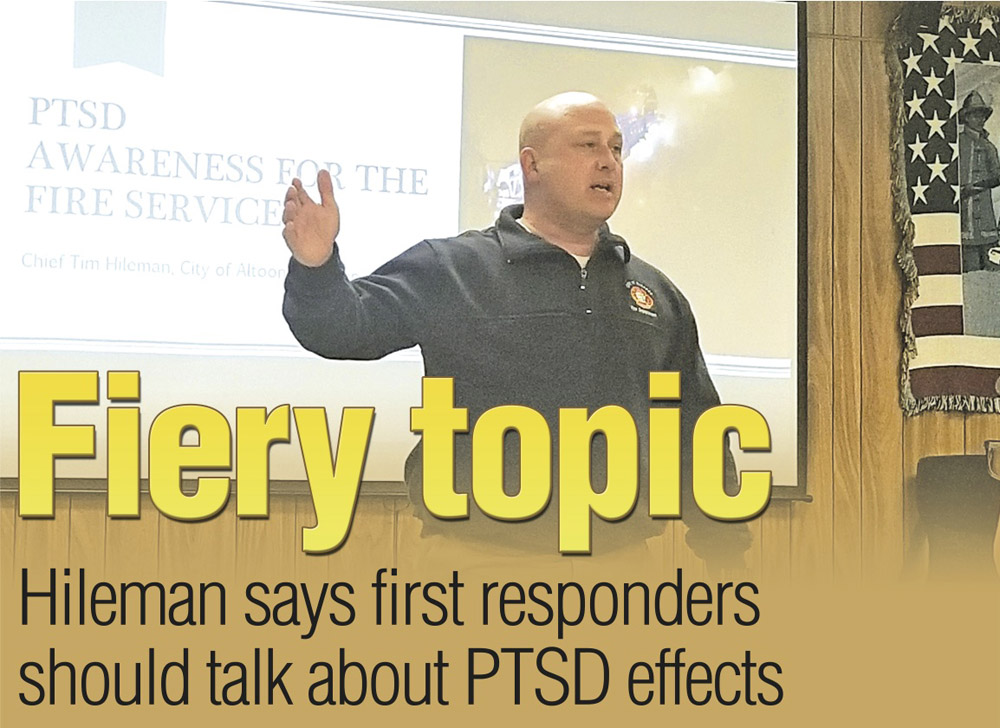
MARTINSBURG — Post Traumatic Stress Disorder, or PTSD, is something commonly associated with combat war veterans, but according to Altoona Fire Chief Tim Hileman, cases of PTSD among the firefighting community are rising, and all members need to be trained to identify the signs.
The numbers are staggering.
According to the International Association of Fire Fighters, 37 percent of firefighters and paramedics have PTSD. Even more alarming, the IAFC reports that 49 percent of firefighters have considered suicide, while 16 percent have attempted to take their own lives.
As a 32-year Army veteran, including four deployments, Hileman has seen first-hand how devastating PTSD can be.
“I had to go to the funerals of those soldiers who committed suicide because they were unable to handle the stress of coming back after being in those traumatic situations,” he said during a presentation earlier this week to five Southern Blair County area fire companies.
When Hileman, who has been Altoona’s chief since 2012, transitioned back into civilian life and resumed his career as a firefighter, he saw the fire department was experiencing the same kind of stress his men in the Army were, but had no clear way of addressing it.
“We are kind of a lost group,” Hileman said. “Firefighters see all kinds of stuff, and they bottle that stuff away and don’t ever deal with it.”
Support system vital
While the military has programs to help address PTSD, firefighters have largely been left to deal with it on their own.
“In the Army, we have suicide awareness classes, and we do all these checks, do all these things to make sure that our guys and gals are taken care of,” Hileman said. “In the fire service, we do nothing. We just do fire service.”
Seeing a need to help those who may be silently suffering, Hileman has put together a program to bring PTSD among firefighters out into the open so those who need help can get it.
In partnership with Bucks County Community College, Hileman offers PTSD awareness training to community fire departments across the state, and on Tuesday, he presented his program at the Martinsburg Fire Hall.
“The point of this class is to give an organization a chance to start talking about PTSD,” Hileman said.
Hileman said that PTSD outside the military “has a stigma” attached and that keeps people from talking about it.
“What we want to get accomplished by this class is to have people feel comfortable enough to speak about it,” he said.
It is the expectation put on firefighters, and that firefighters put on themselves, that can keep them from talking, which Hileman said is a vital step in treating PTSD.
“I’m here to tell you that at some point, you have to find someone to talk to,” Hileman said.
Hileman said a strong support system is key to keeping feelings from bottling up inside and eventually becoming overwhelming.
“PTSD can sneak up on you,” Hileman said. “You need that support structure to help you deal with it.”
Close-knit communities
Williamsburg Volunteer Fire Department Chief Ted Hyle has been in fire service for more than 40 years and said when he first joined the department, mental heath issues were not discussed.
“Back when I first started, we didn’t have any procedures to help people deal with the things we were seeing,” he said.
Hyle said after every call, the entire company sits down and discusses what happened and if anything about the call is bothering them.
“We critique everything after a fire,” Hyle said. “We sit down and talk about everything that happened. I ask if there are any issues, if anyone is having problems with what they saw. If there are issues, we can get them help.”
A challenge facing small-town fire departments is familiarity, and Hyle said that can make it difficult to not only keep emotions in check during an emergency, but also to move on quickly after it.
“Chances are, we personally know the person we are going to help,” Hyle said. “We know them as neighbors and family members, so it is harder. I can go to a call, and I already know the house. I have been there. We have that kind of connection.”
Hyle said after four decades in fire service, the things he has seen have weighed on him, but talking about it has helped keep it from consuming him.
“I have seen more than I should,” Hyle said. “Sometimes the memory sneaks up on me. I sit down and talk with my wife about it, that way maybe it doesn’t build up.”
Focus on communication
Freedom Township Volunteer Fire Chief Ron Henry said he keeps a close eye on his crew and if anyone starts to act out of character, he immediately pulls them aside to talk.
“You get to know these guys pretty well,” Henry said. “I can tell if something is bothering someone. Even if they don’t come to me, I go to them.”
Henry called the “what if” factor one of the main problems his crew faces.
“What if I could have done this differently, or what if we had gotten there a few seconds earlier?” Henry said.
As a young firefighter, Henry had his own “what if” moment that he still thinks about.
It was during a house fire, and the smoke and heat were intense. Henry said they were told a person was in one part of the house, but it turned out she was in another.
“What if I had gone two more feet? What if I had gotten there sooner?” he said.
Henry sought out peers to talk to about it and that not only helped him emotionally, it also saved his career in the fire service.
“I almost quit because of it,” he said. “But I was able to talk to some people about it and that helped me a lot.”
Martinsburg Volunteer Fire Company Chief Randy Acker protects his younger recruits.
“When we go on a call, if it’s going to be graphic I don’t want new people on the scene,” he said. “I will pull them back onto traffic detail. I want them to work their way up to being involved in the more intense parts of an emergency so they don’t get overwhelmed right away. I want to make sure they will be able to handle it.”
Acker said his crew talks after every call and meets the day after any call that involved severe injuries.
“I have had mental health professionals and clergy come in to talk to the crew at times,” he said.
Acker said he found out about Hileman’s class at a recent meeting of the Blair County Fire Chiefs Association and thought the fire companies in the southern end of the county would benefit from it.
Hileman has gotten requests to teach his class at fire departments from Pittsburgh to Philadelphia, and that means more companies are recognizing the importance of not only recognizing the symptoms of PTSD, but they also are willing to take the necessary steps to help those suffering from it.
“The need and demand for this class has been really high,” he said. “Once we get through this class and they are armed with the information, they will probably never think of PTSD in the same way again.”
Mirror Staff Writer Rick Boston is at 946-7535.
Local News

Just a little peep
S&P upgrades Altoona’s credit rating to A-plus
One of the nation’s top three credit rating agencies has upgraded the city of Altoona’s credit from A to ...
Ghost Town Trail extension completed
Ghost Town Trail extension completed
Deadline extended for defendants to respond in McCort religious discrimination suit
Twelve school districts named as defendants in a recent religious discrimination lawsuit filed in the U.S. District ...