
The new hot spot
Library helping to bridge area’s digital gap
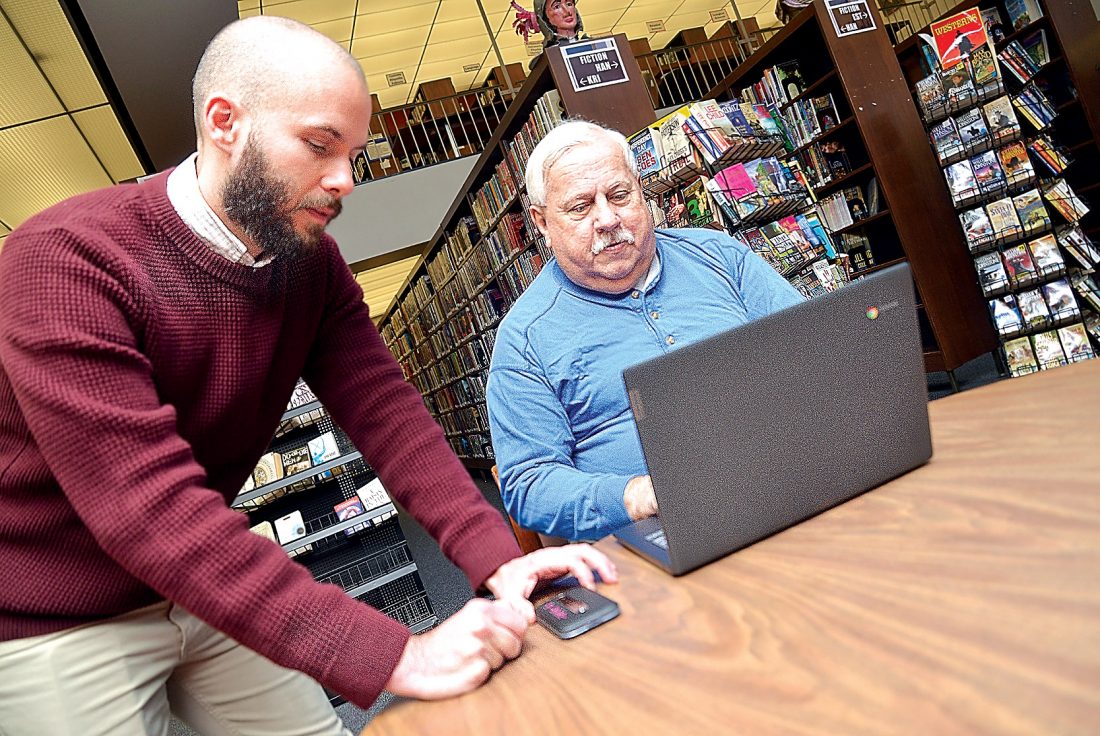
Altoona Area Public Library Supervisor of Information & Community Education Services Josh McConnell (left) helps Jim Lebda of Smithmill, Clearfield County, connect a laptop to a T-Mobile hot spot device. Mirror photo by Patrick Waksmunski

Jim Lebda of Smithmill activates a T-Mobile hot spot device at the Altoona Area Public Library. The devices are available for rent –– $15 for two weeks –– for library cardholders age 18 and older in good standing. Mirror photo by Patrick Waksmunski
Altoona Area Public Library Supervisor of Information & Community Education Services Josh McConnell (left) helps Jim Lebda of Smithmill, Clearfield County, connect a laptop to a T-Mobile hot spot device. Mirror photo by Patrick Waksmunski
Jim Lebda of Smithmill activates a T-Mobile hot spot device at the Altoona Area Public Library. The devices are available for rent –– $15 for two weeks –– for library cardholders age 18 and older in good standing. Mirror photo by Patrick Waksmunski
Trending
The Altoona Area Public Library has carved a niche for itself as it helps area residents bridge a digital divide by offering both Wi-Fi access to the public on its campus and through loans of hot spot devices that give patrons personal internet access.
Between July 2018 and June 2019, the library had 135,126 individual Wi-Fi connects, according to Joshua McConnell, supervisor of Information & Community Education Services. In that same period, 16,865 individuals used library computers for an average computer session of 60 minutes. Many library patrons log into their personal email and use the library's printers to create a hard copy -- most often of applications for various Commonwealth services, such as car registration or for a driver's license, as those websites aren't as "mobile friendly," he said.
The library's free Wi-Fi enables residents with mobile devices to access the internet.
"I would be hesitant to draw any conclusions about whether or not the usage is increasing and what that means for the community. It could be that, as people become more aware of the service, it is being used more due to word of mouth," McConnell said. "However, I'm sure the high cost of internet access is a component of the demand for the hot spots. People may not be financially able to afford a monthly bill and set-up fee for cable internet or even DSL, which has only increased over the years, but they can afford (sporadically) a $15 charge for internet via the hot spot for two weeks."
The Altoona Library has eight T-Mobile Hotspots available for loan to library card holders. The wallet-sized device can be checked out for a two-week period by adults age 18 or older in good standing with no outstanding fines. The cost is $15 for 14 days.
Most often, McConnell said, the hot spots come in and immediately go right out as a waiting list exists.
On one mid-January day, the library had four people on a wait list. It can be longer during summer vacation and other holiday seasons as parents often use them to keep children "connected" on vacation road trips.
The area where the device is to be used must have a quality service/signal through T-Mobile, McConnell said, noting that some parts of Blair County remain without any internet service.
In addition to affordability, some 800,000 Pennsylvanians in more rural areas of Pennsylvania have little access to broadband service providers, according to a Penn State study on access to broadband. Fulton County has an estimated 8,000 residents without access to 25mbps wired broadband out of a total population of 14,506 -- that's 55.2% of the population, according to statistics from BroadbandNow: 2014-2018 American Community Survey 5-Year Estimates.
Southern Alleghenies Planning & Development Commission is assessing broadband connectivity in Bedford, Blair, Cambria, Fayette, Fulton, Huntingdon, Somerset and Westmoreland counties, according to Grants Coordinator Stacy LoCastro. The Regional Broadband Task Force's goal is to capture a better picture of "actual" connectivity access than what is available from the FCC.
In September, the commission received a $50,000 federal grant to conduct a broadband and cellular feasibility study and is using Design Nine to conduct face-to-face regional meetings with county commissioners, business leaders electric cooperatives and residents supplemented with telephone and email surveys of households and businesses.
The task force's mission is "to create a comprehensive action plan that guides affordable, reliable network implementation for all businesses and residents in the region," according to information from the Southern Alleghenies commission.
The assessment is to complete a feasibility study in the eight-county area to determine how to increase access and availability of broadband and cellular services to residents and businesses. After an initial determination, the feasibility study will provide a needs assessment and analysis of current and future bandwidth requirements, inventory of existing and planned broadband assets and fiber and vertical asset assessment (what existing high structures could be used for towers).
For Blair County, with a population of 123,842, 1.6% or 2,000 individuals, lack access to wired broadband. In Cambria, those without access is 2.2%, or 3,000 individuals.
LoCastro said connectivity impacts a county's ability to retain its youth and attract new residents and businesses.
Only 66% of Harrisburg households had a broadband subscription between 2013 and 2017, U.S. Census data shows. Across Pennsylvania, that figure is 76%. Close to 20% of households didn't have a computer at home.
That lack of access is tied to poverty. According to a Pew Research report, roughly 44% of adults with household incomes of less than $30,000 nationwide lack access to broadband internet. The FCC defines broadband as 25 megabits per second download speed and
3 mbps upload speed.
Sheri R. Collins, the acting executive director for the Pennsylvania Governor's Office of Broadband Initiatives, said a "majority" of those without broadband access are from rural areas in Pennsylvania.
Collins said libraries play a "crucial" role in healing Pennsylvania's digital divide, providing a point of access for thousands of families who need to apply for jobs, do homework and connect with the world - but added that they can't be a permanent solution to a lack of access.
"We can't rely squarely on the libraries to solve this issue," Collins said. "People really need to have internet connectivity within their own home."
The Pennsylvania Broadband Initiative is mostly focused around access in rural areas, offering incentives to companies looking to expand access. The Broadband Investment Incentive Program made $35 million available for companies that were expanding access.
"It should be no different than electric or water and sewer," Collins said of broadband access. "It is more of a necessity today than it is a luxury."
Some gains have been made in internet access by lower-income individuals, the Pew Research report notes. Many are reliant on smartphones as their point of access, but it's more difficult to perform tasks such as applying for jobs on a phone compared with using a computer.
The Altoona site of Pennsylvania CareerLink moved into new quarters within the Altoona public library during the past summer so no official statistics are available, according to Gwen Fisher, site administrator for Blair and Bedford County locations. However, Fisher described the traffic as "steady," as people not only use the computers to file unemployment claims but also to access the assistance of staff who can walk them through the process. Fisher also oversees CareerLink services in more rural Bedford County where broadband internet access is more difficult.
CareerLink staff help job searchers create resumes, access employment sites and assist with building computer skills, Fisher said. Her staff's expertise makes a difference for job seekers -- and also for employers looking to fill positions, noting CareerLink is used by 30% of employers to post jobs and connect job seekers with appropriate skills.
"We have about 11,500 people come through annually," Fisher said. "Our staff made about 14,000 job referrals. When unemployment is low, more job postings are open longer as there are fewer people to fill them."
Harrisburg-area resident Amy Boyd's job search was stopped in its tracks when her home computer broke a few years ago. For many, a crashed computer is a major inconvenience. For Boyd, it was the end of her home internet access.
"The funds were not there for me to get my computer fixed," said Boyd of Highspire, near Harrisburg.
Internet access is abundant in the Harrisburg area, but some of the region's residents struggle to afford service. Without home internet, Boyd turned to libraries to continue her job hunt.
For Christopher Black, a supervisor at the McCormick Riverfront Library in Dauphin County, lack of internet access isn't just a rural issue. He said the library is the only point of internet access for many of its patrons, many of whom need access to apply for jobs or talk to family.
"A lot of times, what we're seeing is people coming in to essentially apply for jobs because they don't have access to a computer at home or they don't have access to the internet at home," Black said.
Boyd encouraged residents who struggle to afford home internet access or computers to use the library as their point of access. As more and more services require the internet to access them, Boyd said libraries will continue to be a bridge over the digital divide.
"You don't have to come in with the knowledge," Boyd said. "Whatever it is, the librarians are there, the library is there."
Mirror Staff Writer Patt Keith is at 949-7030.
Reporter Bennett Leckrone -- beckrone@pennlive.com -- also contributed to this story.