
Staying in contact
Digital radio technology helps hobbyists ham it up
Trending
Some are in it just for fun, to see who they can talk to in faraway places.
Others do it to help their community because ham radio operators often assist in rescue situations.
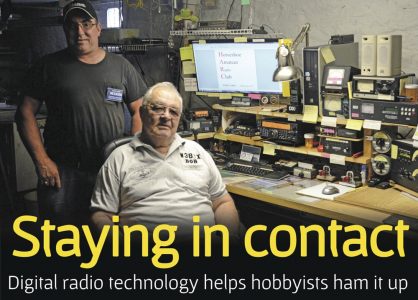
Still others do both, combining public service with a hobby that goes back decades, yet is new and incorporates the latest in digital technology.
Robert Gutshall of Altoona got his ham radio operator license in 1955, at age 11. He'd heard about a group, the Horseshoe Amateur Radio Club, and wanted to know more about it.
The club got its official start in 1938 and originally met at what is now the Blair Bedford Central Labor Council building in Wehnwood. The group now meets at the United Fire Department Hall in Logan Township.
Gutshall said he had a mentor when he started, an "older ham'' named William Callan, who was good with electrical devices. Callan helped him build his own transmitter from recycled materials.
"It was like it was brand new,'' Gutshall said. "I was in heaven.''
Just like those who want to be ham radio operators today, Gutshall had to take a test to get his license. But unlike those who take the test these days, he had to learn Morse code, which hasn't been required for test-takers since 2007.
Once he got his license, Gutshall has enjoyed talking, or as the hams call it "working contacts,'' to the famous and the not-so-famous over the years. He's got a stack of what looks like postcards that have the call signs of some of the people he's talked to around the world, some close by and some continents away. He keeps many of his cards, called QSL cards, in scrapbooks.
A call sign is assigned to a ham radio operator with a license, Gutshall said. The number designates what country and region the operator lives in and also the class distinction of the license. Call sign cards aren't necessary for operators to obtain, but many get them printed, and when they reach someone on the radio, they exchange cards so that they can collect them. The cards are also a written record of a call, Gutshall said.
He has cards from singers Johnny Cash and Joe Walsh and actor Tim Allen, but Gutshall said one of his prized cards is from the former King Hussein of Jordan, whose call sign is JY1 and his wife's call sign is JY2.
"I didn't know what to call him,'' he said. "He said, 'Everyone calls me your majesty, but you can call me Hussein.' I said, 'Well, you can just call me Bob.'"
A multi-faceted club
Gutshall has also done his share of public service, working with the local emergency officials to assist with rescue calls.
He's part of the club's mission that helps nonprofit groups with races, walks and other events that involve physical activity, such as long-distance marathons through areas that have poor cellphone service. Ham radio operators are vital for communication such as when runners fall ill or have an injury like a sprain along a trail, said Kevin Lear, the Horseshoe club's current president.
Compared to Gutshall, Lear is a newbie in the world of ham radio operators, but Lear is catching up fast. He remembers growing up hearing about citizens band radios in the 1970s and recalled talking to people on CBs.
Lear got involved with ham radios when he was older because he'd married a woman from Russia and they were interested in contacting her relatives overseas.
"I started with Bob (Gutshall) as my first contact,'' Lear said. "I was looking for a way to talk to my wife's parents in Russia.''
Like Gutshall, Lear is involved with ham radios as a hobby and also for public service. As a club member and also as president, he helps with assisting at the nonprofit events providing emergency service if needed. Those events include the Hollidaysburg YMCA Triathlon and its other races and Bike MS: the Glimcher Keystone Country Ride, a 150-mile bike ride.
"Some of the equipment uses GPS, and we can use the GPS to locate a biker's position even if their cellphone isn't working,'' Lear said.
Of course, Lear likes the hobby end of ham radios, too. He has talked to an astronaut in space and even exchanged photos. Then there was one night when Lear was just flipping through the dial and he happened on a lonely scientist in Antarctica.
"He was just looking for someone to talk to,'' Lear said.
The Horseshoe radio club has all kinds of members, from single people to couples and even entire families.
"Boy Scouts will get involved because they can earn merit badges,'' Lear said.
Young people are getting interested because there's now digital technology in the form of kits that they can use to build electronic devices that connect to computers, smart phones and radios. Last year, three students from the Greater Altoona Career and Technology Center got their ham radio licenses, Gutshall said.
Public service
But not every ham radio operator wants to flip through the radio dial and just chat or see who's out there.
Local ham Drew McGhee, who's also project coordinator in the Office of Information Technology at Penn State Altoona, is a ham radio operator who is solely interested in using his ham skills for helping in rescue work.
"My thing has always been public service,'' he said.
When McGhee was younger, he served as a volunteer firefighter, which is where he first got interested in rescue work. He continued that service throughout his academic years while he earned his undergraduate and master's degrees in journalism and communications.
McGhee, along with Gutshall, serves on the Blair County Emergency Management Committee, a large group that keeps tabs on how prepared the county's emergency services are for natural and manmade disasters. McGhee said ham radio operators are of particular importance because they're "one phase available when all else fails.''
He recalled situations in the past on both a local and national scale where hams helped emergency officials. Hams were alerted and put into action on 9/11 because cellphone capabilities quickly overloaded and went down when people frantically tried to reach friends and family, he said.
McGhee also remembered an area situation when ham radio operators proved helpful during a natural gas explosion in Lakemont a few years ago. No matter the occasion, though, the hams are ready, trained and prepared to help wherever they're needed, he said.
"When we get called in, somebody is having a really bad day,'' he said.
The beauty of using ham radio operators in an emergency is that all of the assisting agencies get put on one system, McGhee said. Many times, the various responding governmental agencies are on different frequencies, but if everyone loses power and they're relying on the hams, they're actually in a better situation, he said.
"When the power fails, it puts everyone on one system,'' he said.
Hams are also helpful for relaying outbound messages that people in a certain area are alive during natural disasters, such as hurricanes or earthquakes. The hams have to be careful never to accept money or any kind of payment to relay messages because that would violate the conditions of their licenses. But they deliver many health and welfare messages in time of need as part of their public service role, according to McGhee and Gutshall.
"Those are the kind of people who are really in it for the long haul,'' McGhee said.
Although ham radio operators weren't around to assist with the Johnstown Flood of 1889, when just about the only type of long-range communication was the telegraph, by the time of the next devastating flood in 1936, hams could assist sending calls out for help, Gutshall and McGhee said.
By the time of the Johnstown flood in 1977, the Horseshoe ham radio club members involved in emergency operations were well established and responded quickly, helping to limit the devastation, Gutshall said.
"This time, we had long-range repeaters and we were able to communicate from the site (directly) with all portable operations and also with Washington, D.C., and Harrisburg ... for all logistical support,'' Gutshall said.