
‘That date hangs heavy on my heart’
10 years ago, two locals were killed by man claiming he had PTSD
Trending
Ten years ago on a placid early spring day, Nicholas A. Horner, then 28, a distraught Army veteran of the Iraq war, shot his way into the Subway restaurant on 58th Street, purportedly to obtain money.
In opening fire at the restaurant's back door, Horner killed 19-year-old Scott Thomas Garlick, a Hollidaysburg Area High School senior who was preparing for graduation and for college life, and seriously wounded Michele Petty of Duncansville, both Subway workers.
Defense attorney Thomas M. Dickey claimed that Horner was oblivious to what he did, that he was suffering from post traumatic stress related to his war experiences and was having a flashback to the battlefield.
The prosecution claimed otherwise. Assistant District Attorneys Wade Kagarise and Jackie Bernard, now serving as judges in the Blair County Court of Common Pleas, argued Horner was trying to rob Subway, and that he was enamored with the gun he was carrying, a weapon his father had given him for his own protection.
After the robbery, Horner, on foot, disappeared momentarily, but as police claimed, he emerged in the parking lot of the Ellenberger apartment complex four blocks west of Subway, where he shot and killed 64-year-old Raymond Williams, who was attempting to retrieve his mail for the day.
In a desperate attempt to flee, Horner took Williams' keys and entered a nearby car, apparently thinking the retiree had just gotten out of the vehicle.
The keys didn't work, and Horner, it is believed, shed his gun and continued what became a foot race with approaching police.
It was April 6, 2009, a day of extreme violence but also a day that drew in response great bravery, heroism and compassion.
One of the Subway workers, Cynthia Harker, 64, responded to Horner's gun pointed at her and his threat to kill, by walking toward him and asking him what he wanted.
She attempted to stop the bleeding of severely wounded Garlick, and she comforted Petty, lying next to the teen, who had been told by Horner if she raised her head there would be consequences.
There was the Altoona police officer who decided that rather than shoot Horner, he wanted him alive, and he went one-on-one with the Army veteran.
Another Altoona police officer was moved to great emotion when he saw a small child in the Subway restaurant sitting, crying, refusing to leave the safety of the floor.
And there was Petty herself, who, when the first paramedic arrived, refused treatment, telling him to go to the badly injured Garlick.
April 6 also is a day that still yields emotion from Melanie Kollar of Chambersburg and Matthew Williams of the Greensburg area -- Raymond Williams' children.
Although it has been a decade, Melanie Kollar said, "That is a hard day every year. It hasn't changed, but it triggers memories."
Her memories of her father are good, but the memories of the night of April 6 are highly emotional -- when her mother, Christina, called her and told her through tears her dad was dead.
She remember her tears and those of her two children and the efforts of her husband to comfort everybody. She also remembers the long ride to Altoona.
Former Duncansville police chief, now Blair County Sheriff James Ott, recalled in an interview last week, "That date hangs heavy on my heart."
He was the first officer to arrive at the scene of the Williams shooting and was immediately confronted by a man standing near a truck screaming, and pointing, "He just up and shot him. He just shot him."
Ott wasn't certain the man was pointing to where the assailant went or whether it was a ploy or trick to detour the officer so the assailant could get away.
As Ott scanned the distance, he saw a man stick his head above the cars. He now knows it was Horner, who had Ott in his sights.
Ott doesn't know why Horner didn't kill him. Was it that Horner did not want to kill a police officer, or was it that Horner had already ditched his gun, which was eventually found in one of the cars in the apartment complex parking lot?
Ott doesn't know, but it bothers him greatly that he was in so vulnerable of a position that day, and he feels lucky to have survived.
Horner began running, and Ott was on the chase.
The police story
Altoona police officers Mark Martino and Scott Douglas spent the day as part of the city's bike patrol, and as their shift was coming to an end, the department's officer in charge, John Miller, requested they work overtime.
They agreed, but it meant putting away their bikes and transferring to cruisers.
Recalling the case in a recent interview, Martino said he drove to his home near Wehnwood, several miles from the 58th Street Subway restaurant, to get something to eat, when suddenly he heard a tone that indicated a weapon's call was about to ensue.
He was informed that shots were fired at Subway. He got back in his car and went to the 58th Street Subway, but was informed the shooter had exited through the back door, along the stream bed behind Subway.
He decided to look for the shooter, first going to a nearby convenience store to make sure the people there were not in danger.
He was then directed to the scene of the second shooting on Ellenberger Lane.
Ellenberger Lane cuts across Maryland and Kentucky avenues and is the location of several businesses, one being Sel-Lo Oil Co., a car museum, the Miracle League of Blair County baseball field and the apartment house where Williams lived.
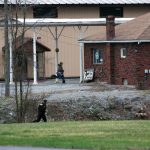
As Martino remembers, he saw Williams on the ground and saw another man pointing. There were officers on foot, including Douglas, who was captured in a photograph taken by freelance photographer Tom McLaughlin of Hollidaysburg and published in the Mirror. In the photo, Douglas had his gun drawn and was in pursuit of a fleeing Horner.
Martino said other officers, who included Ott, Rick Benzel of Logan Township and Dave Tracy from the city, were in pursuit.
Two of the officers fired at Horner, who continued to run.
In his cruiser, Martino went ahead of the officers on foot, and he came to a small bridge that led to the dead-end parking lot of a tire company on the other side.
The officer was cautious about getting his cruiser into a position where the shooter could come from his rear. He had recently read an article that said, "Don't let your cruiser become your coffin."
Martino said a small prayer: "Lord let me do the right thing, whatever the right thing is."
"Boom, suddenly Horner appears in front of me," Martino said.
Horner tripped and fell.
The Altoona officer pulled his gun and exited the cruiser.
"I tell him, 'You're under arrest,'" Martino remembered.
Martino noticed that Horner was not armed, but he also realized Horner had no intention of being placed in custody.
The veteran officer put his gun away. He said, "It was him or me. The fight was on."
The went at each other, fist-to-fist.
Ott, running after Horner with the other officers, said the exchange of punches was so loud he heard them from 60 or 70 yards away.
"Mark was in a fight for his life," he said.
Martino was able to wrestle Horner down as the other officers arrived, but even then, Horner continued to struggle.
Horner began trying to explain, stating, "It wasn't me."
Martino responded, "What wasn't you?"
Martino knew he had the right guy, and he knew that Horner wasn't going to get away.
But, in view of Horner's comments -- that someone else was involved -- state and city police spent a great deal of time after Horner's arrest searching for a possible second suspect.
Back at Subway
Meanwhile, at the Subway restaurant, Altoona patrol officer John Polheber entered with his gun drawn.
He was startled by what he saw. All the customers were under their tables. No one was behind the counter.
The victims of the shooting, Garlick and Michele Petty, were in the back room where Horner had entered.
There was a woman trying to stop the bleeding from the teen's critical wounds, and when a paramedic arrived, Petty directed him to first treat Scott.
Polheber considered Petty a hero that day. Although she was shot herself, she did not ask for help. As Polheber remembered, she said, "I'm fine. Go to him."
Garlick died from his wounds, and Petty, shot in the left leg and hip area, spent months in rehabilitation.
Polheber, a crime scene technician, began to line up witnesses in an effort to determine what happened. He was soon joined by Detective Robert Hainely.
The officer, who eventually got a degree from Penn State and taught a psychology course at Penn State Altoona, now works for the Pennsylvania Commission on Crime and Delinquency.
He remembers after coming out of the back room, the people in the restaurant were standing, except for one little girl in tears who had come into the restaurant with her grandparents. She wouldn't get off the floor. She felt safe there, he said.
Polheber comforted her. "I just remember this poor, scared little girl," he said.
Horner was eventually charged with two counts of first-degree murder plus a plethora of other offenses, and testimony at his trial revealed what had occurred that day.
Garlick had just arrived for work.
Employees there had been hearing what sounded like firecrackers in the back of the restaurant but nobody had checked to see what was occurring.
Garlick had started his duties for the day -- he gathered the trash and was taking it out back. When he opened the door, Horner was there with a gun and shot him. Horner entered the rear of the restaurant and also shot Petty, who went down.
Horner advanced to the front of the restaurant and there confronted Harker, a longtime Subway worker.
She faced the man with the gun. He said he was going to kill her.
Harker walked toward him and said, "Don't kill me. Don't shoot me."
Then she asked, "What do you want?"
He said he wanted money.
Harker went to the cash register and began putting the bills in a sandwich bag. Horner didn't want the change, just the bills.
Horner left with $133, and at that point, Harker took over. She tried to call 911. It was busy. She summoned the owner of the restaurant, Terry Mulhern.
She first told the customers to leave, but then noticed Horner through the window. She directed the people to stay so they wouldn't run into him.
Harker then used paper towels in an effort to stem Garlick's bleeding. She also ended up comforting Petty.
Case not isolated
Altoona has not been immune from the senseless gun violence that has engulfed other areas of the nation, both small and large.
In 2005, Miguel A. Padilla of Altoona was denied permission to enter an after-hours club so he went to his car and returned with a handgun containing a laser sight, killing the owner of the United Veterans Association on Union Avenue, Alfred Mignogna, 61; the doorman at the club, Fred Rickabaugh, 58; and a patron, Stephen Heiss, 28.
Padilla is serving three life sentences at the State Correctional Institution in Greene County.
A little over six years ago, Jeffrey Lee Michael, 44, of Juniata Valley Road, predicting a worldwide apocalypse, went on a rampage with a gun, killing Kimberly A. Scott of Duncansville as she was decorating the Juniata Valley Gospel Church for Christmas, and neighbors, Kenneth Lynn, 60, and Lynn's son-in-law, William Rhodes Jr., 38.
Michael died in an exchange of gunfire with state police but not before injuring three troopers.
An apology
Almost immediately after his arrest, Horner, who had served two tours in Iraq and was part of the initial entry into Baghdad, reported he was suffering from post traumatic stress disorder.
In a letter to the Altoona Mirror two months after the shooting, he apologized by saying, "I am sorry to all of Altoona. I know I scared the whole town. I can't even begin to explain how sorry I am to the family and friends of the victims. This is such a tragity (spelled incorrectly; he admitted he had trouble with spelling)."
But he said, "I don't know how or why this happend (sic)."
"I'm not looking for forgiveness or simphy (sic). I just want people to watch for P.T.S.D. cases. There are so many of them. This needs to stop," he wrote.
His problems with post traumatic stress became the focus of his trial.
The trial
It took almost three years before the case came before a jury. Horner changed attorneys and was finally represented by Altoona defense expert Thomas M. Dickey, who was assisted by Pittsburgh attorney David DeFazio.
DeFazio was assigned to represent Horner in the death penalty phase of the case, if there was one.
Dickey wanted to present an insanity defense to the jury.
To be successful, the defense would have to show Horner did not know the difference between right and wrong, but the trial judge, Jolene G. Kopriva, denied the defense petition.
Dickey, however, proved to be insistent, and during the jury selection phase of the case, he filed a "King's Bench Petition" with the Pennsylvania Supreme Court, hoping to obtain permission from the highest court in the state to proceed with the insanity plea.
Justice Seamus McCafferty, a veteran of the Marine Corps, put a stop to the selection of the jury. When Kopriva asked permission to continue jury selection pending the outcome of the Supreme Court review, McCafferty replied, "Stop means stop."
That meant jury selection had to begin all over again and resulted in further delay of the trial.
Eventually, the Supreme Court decided not to take up the insanity issue, and that enabled a new selection process to begin.
Kopriva, however, permitted the defense to argue that Horner was under "diminished capacity" during his shooting spree.
That meant the jury could consider a lesser degree of murder.
During the trial, the defense called a Minnesota psychologist, Ernest Boswell, who testified that while Horner suffered from post traumatic stress, it was not the cause of his problems on April 6, 2009.
The psychologist contended Horner was in a dreamlike state or a drug-induced delirium under which he could not form the intent to kill.
Horner was being treated for anxiety, paranoia, depression and panic attacks.
However, the defense insisted post traumatic stress was the root of Horner's problems.
Court records show that he reported his first bout with post traumatic stress after witnessing a bomb dropped by the Air Force, killing two of his fellow soldiers.
During the trial, the defense contended he witnessed a bus blow up.
Court records also show other instances of violence and the brutality of war that he witnessed.
His second tour in Iraq reinighted his post traumatic stress, Horner said.
By the time he moved to Altoona -- so he could be near the Van Zandt Veterans Administration Hospital -- Horner felt he needed a gun to protect himself.
But on the day of the shootings, he reported he felt good enough to go with his wife, Windy, to buy bicycles as Easter presents for the children and to purchase computer parts.
According to trial testimony, when the couple went to Walmart and another vehicle cut off the Horner vehicle, which was driven by his wife, Horner began to unravel.
That led to an argument, and he left the car.
Horner spent much of the afternoon in the Holiday Bowl, watching bowlers and consuming beer.
It was there that attorney Dickey felt Horner's post traumatic stress was triggered, possibly due to the sound of the bowling balls hitting the pins.
Dickey said that Horner walked along the stream bed between the Logan Valley Mall and Subway and, as in Iraq, he was in a high-alert mode.
"I believe he (thought he) was back in Iraq," Dickey said during a recent interview.
He said he wasn't justifying what happened because the shootings led to the loss of "some very dear people," but he said, "mental illness exists, and it is relevant."
War, Dickey said, changes people.
A history buff, Dickey said even back during the Civil War they had a term for post traumatic stress: There were people who had "seen the elephant," he said.
"One thing I'd like to say about the homicide cases I do: Everybody hates the lawyer. These are cases where I defend the Constitution. I am always sad about the victims. In almost every occasion, I push back tears when I read victims' statements. I always feel sad about the victims," the veteran defense counsel said.
"This wasn't a situation where a fired employee goes back to his workplace and tries to kill everybody. He wasn't an angry guy."
Prosecution attorneys Kagarise and Bernard disagreed.
"I do not equate Horner's veteran's status in any way with those crimes that were committed," Bernard emphatically stated. "The jury rejected PTSD as justification for the killings."
She said the scariest part of the case was how random the shootings were, but she stressed that when the prosecution looked at Horner's acts that day, "Every action he did, he intended to do."
He had an argument with his wife and left the car. At the bowling alley, she said, he was cordial, talked about signing up his family for bowling lessons. He stole money. He stole keys from Williams in an attempt to get away. He got in a car that he thought Williams had just gotten out of and tried to start the car.
"Everybody asks, 'Why?''' Bernard said. "We are not required to prove motive."
"Those crimes are crimes against society and the safety of the community. They impact the community," she said.
Kagarise said, "People who kill are not normal. Normal people do not kill people, but that doesn't mean they become insane."
All types of things occur in a person's background, Kagarise said.
"There can be any number of reasons people kill -- a sense of empowerment, financial reasons," he said. "Some things are unexplainable. That's why we are not required to prove motive."
The case was difficult on the victims, Bernard said, adding that she and Kagarise were privileged to work with them. She knows the jury's verdict won't bring back the loved ones who were lost that day, but she said the victims and the families were respectful of the justice system.
"We don't understand," she said. "I can't even imagine of losing someone in a senseless crime."
Horner was found guilty of the two murders and received consecutive life sentences plus 29-58 years.
The jury split 6-6 on the imposition of the death penalty.
Dickey prepared an appeal, but Horner decided not to proceed.
"I was absolutely disappointed," Dickey said. "I felt we had a good issue relative to the insanity defense."
Horner, incarcerated at the State Correctional Institution at Albion, did not respond to a request for comment.