
Tyrone Area students working to halt dropouts
Summer pilot program with borough allows youth to be ‘in control’
Trending
TYRONE -- Tyrone Area High School 10th-grader Colby Reed didn't know the definition of "autonomy" when asked recently at Reservoir Park, where he was working as a participant in the school's dropout prevention program.
But Colby knew the concept behind the word, which Merriam-Webster defines as "the quality or state of being self-governing," in his bones -- and his hands.
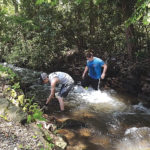
Colby was one of four Tyrone students sprucing up a reservoir feeder stream, mending streambank walls and constructing a series of small dams to catch leaves, sticks and silt before it reaches the lake.
The dams were Colby's idea, said Rick Zupon, case manager for the Central Pennsylvania Graduation Initiative, founded two years ago by Tyrone Area Middle School guidance counselor Matt Kimberlin, with help from Zupon, an employee of Blair Family Solutions, which provides Zupon's services to the school district for free.
Workplace autonomy
The students are working this summer under a "pilot" arrangement with the borough, whose manager, Ardean Latchford, is a believer in workplace autonomy, like Zupon.
"When I ask somebody to do a job, I want them to take ownership," Latchford said. "If I look over their shoulder, they're nothing more than a tool."
When Latchford started his previous borough job as supervisor of the Water Department, "it took me a little bit not to be in the ditch" telling workers what to do, he said.
"Then I realized that for those guys to prosper, I kind of had to get out of the way," he said.
At the stream, Latchford gave Zupon and the students a general idea what he wanted, pointing out the tumbledown walls and debris.
But it was up to the students, under Zupon's guidance, to figure out what to do about it.
The hands-off supervision empowers and engages the students, Zupon said.
If he treated them otherwise, he'd be a hypocrite.
"I don't like someone micromanaging me," he said.
In control
At the creek, Colby feels in control.
Not only did he contribute the idea for the dams, he helped pile up the stones to create them.
He likes working with his hands, he said.
So does 10th-grader Parker Allen, whose father has been employed on farms and at a garage, and whose sisters work at a nursing home.
At school, Colby didn't feel much in control, he said, speaking of a recent English assignment for an essay based on a book.
He didn't have a choice about which book, he said.
He didn't read the one the teacher selected.
Also at school, there's little free time, which contributes to the feeling that the students are under the control of others.
There are only three minutes between 45-minute periods, plus lunch, the students said.
'We listen'
By contrast, at the park, the students take 15-minute breaks every two hours to "huddle" -- to discuss what has been working well and what hasn't, Zupon said.
The kids in the program tend not to feel "connected" in school, perhaps because they're picked on -- Parker said that's happened to him -- or simply because their voices aren't heard, Zupon said.
"We listen to what they have to say," he said.
Colby can tell Zupon about his problems while at the park.
"I get a lot of things off my chest," he said.
There's less stress at the park, ninth-grader Dennis Foster said.
At school, they hear a lot about what they can't do or what they're doing wrong, which leads them to think of themselves as unworthy, Zupon said.
"We teach them what they can do," he said.
Moving forward
The Initiative uses "solution-based learning," he said.
It eschews negative thinking in favor of looking for ways to "move forward," he said.
When the students were building up one section of wall, the lower stones started falling out.
They tried three or four times to fix the problem without disturbing the stones they'd already laid, Dennis said.
Finally, it became clear they'd have to tear out what they'd placed, all the way down to below the problem stones, then rebuild from there, on a solid foundation.
That was OK, Dennis said.
He and the wall were better off for those initial failures, he said.
Latchford is satisfied with the work so far.
"They have it looking beautiful," he said.
After the students finish at the creek, they'll spruce up a flagpole and a wishing well nearby.
Earning school credits
They're working 22 hours a week, earning school credits and fulfilling required community service hours, Zupon said.
Zupon will be a reference for them on future job applications, both before and after graduation from high school, he said.
They'll be more employable as a result of the work at the park, he said.
They're potentially "interviewing for me now," said Latchford, who's taking note of who shows up on time, who works well with others and who is creative.
Students at risk
The Initiative relies on a list of 12 "indicators" that identify students at risk.
Those indicators include high absenteeism; a lack of connection with adults at school; drug and alcohol use; a yen for cyberschool, which kids see as an escape; and failure in one or more classes, especially in ninth grade.
During the school term, Zupon chases down participants at their homes when they don't show up, connecting them with teachers and others, helping them learn what it takes to get and keep a job, Kimberlin has said.
The program has created a work opportunity at the high school: a cafe located near the entrance.
The shop teaches the students "soft skills" needed to sustain employment, he said.
The program so far has identified 30 at-risk kids.
Of those, there have been 11 eligible seniors.
Eight of those have graduated, Zupon said.
Latchford wasn't sure what to think of the program when Kimberlin approached him in August, but when he heard the full explanation, he succumbed.
"It's something this area really needs," said Latchford, whose family recently started a post-high-school scholarship fund in honor of his late father, who always regretted not graduating with his high school class in 1953 -- even though the lack of a diploma wasn't as big a detriment as now to a young person's future.
Zupon and Kimberlin think the Initiative can be replicated in other communities.
The kids are learning "real live life skills," Zupon said.
Mirror Staff Writer William Kibler is at 949-7038.