
Like its trains, Gallitzin still chugging along
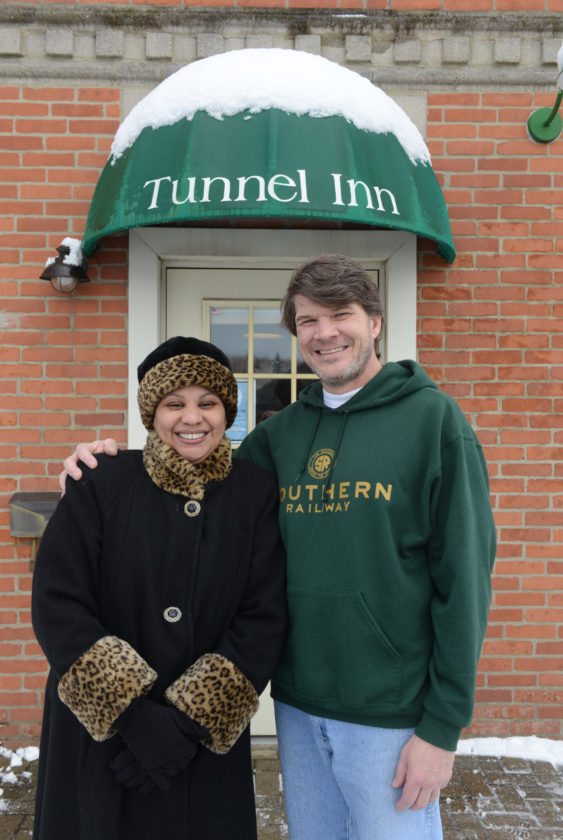
By Gary M. Baranec Gallitzin’s railroad heritage enticed Migdalia Salaman and Robert Elder to move from Massachusetts to run the Tunnel Inn, a bed and breakfast.
03/06/18 By Gary M. Baranec Gallitzin for Progress
By Gary M. Baranec Gallitzin’s railroad heritage enticed Migdalia Salaman and Robert Elder to move from Massachusetts to run the Tunnel Inn, a bed and breakfast.
03/06/18 By Gary M. Baranec Gallitzin for Progress
Trending
GALLITZIN -- A huckleberry patch once abundant with fruit sat on the outskirts of Gallitzin Borough when Irene Szynal was a child.
When in season, Szynal, now the borough's secretary, would collect berries by the bucketful to later sell for spending money.
"You'd end up making hundreds of dollars through the summer picking berries," she said. "I got my school clothes from my berry money."
Now, that berry patch is no more.
"They just sort of died out," Szynal said.
The fate of the berry patch somewhat mirrors that of Gallitzin, a community once rife with commerce spurred on by industry -- coal, railroad and steel.
Those industries have nearly disappeared, and high-paying jobs went with them.
So like the berry patch, Gallitzin too has dwindled to a community with many dilapidated buildings and a population of only about 1,600 residents.
But Szynal and other borough leaders are confident that the town is on track for growth as its railroad past drives tourism and new infrastructure carves a path for development.
The community of Gallitzin officially became a borough nearly 145 years ago in December 1873.
By Gary M. Baranec
Gallitzin's railroad heritage enticed Migdalia Salaman and Robert Elder to move from Massachusetts to run the Tunnel Inn, a bed and breakfast.
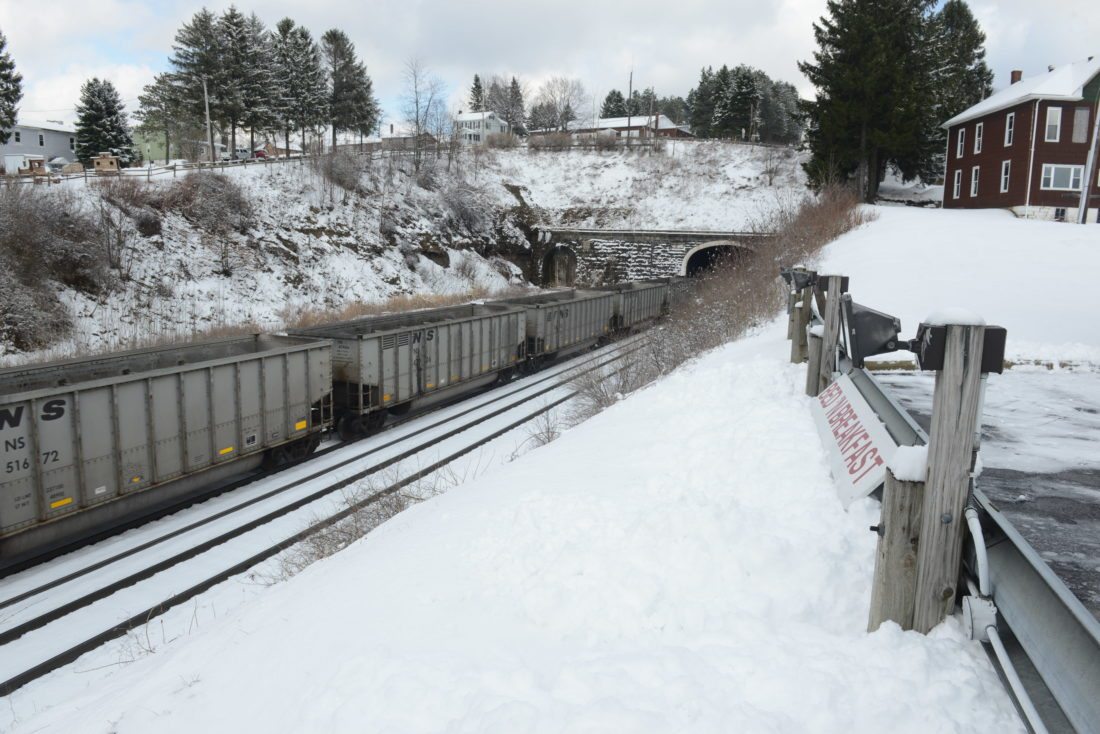
The borough is result of years of work conducted by Pennsylvania Railroad employees who blasted a set of tunnels through a final hill at the top of the Allegheny Front starting in the 1850s.
Two of those three tunnels are still operational today, though one was enlarged in the early 1990s to accommodate larger double-stack trains.
It was the settlements of immigrant workers, who built the tunnels, that eventually became the boroughs of Gallitzin and neighboring Tunnel Hill, said Arthur Julian, a lifetime, civic-minded borough resident.
"It was kind of significant at that time. And it was quite an accomplishment," Julian said, touting the tunnels as an engineering feat.
The tunnels were vital to the transportation of goods moving west on the railroad's Main Line, said 91-year-old Julian.
A steep incline stretches before trains traveling west from Altoona toward Pittsburgh, and it was a grade that proved near impossible for the engines of decades past, he said.
"The elevation was too much," Julian said. "If you put too many cars on it, it was not going to go."
Tunnels, he said, were the solution, allowing locomotives to power through instead of over the steep grade.
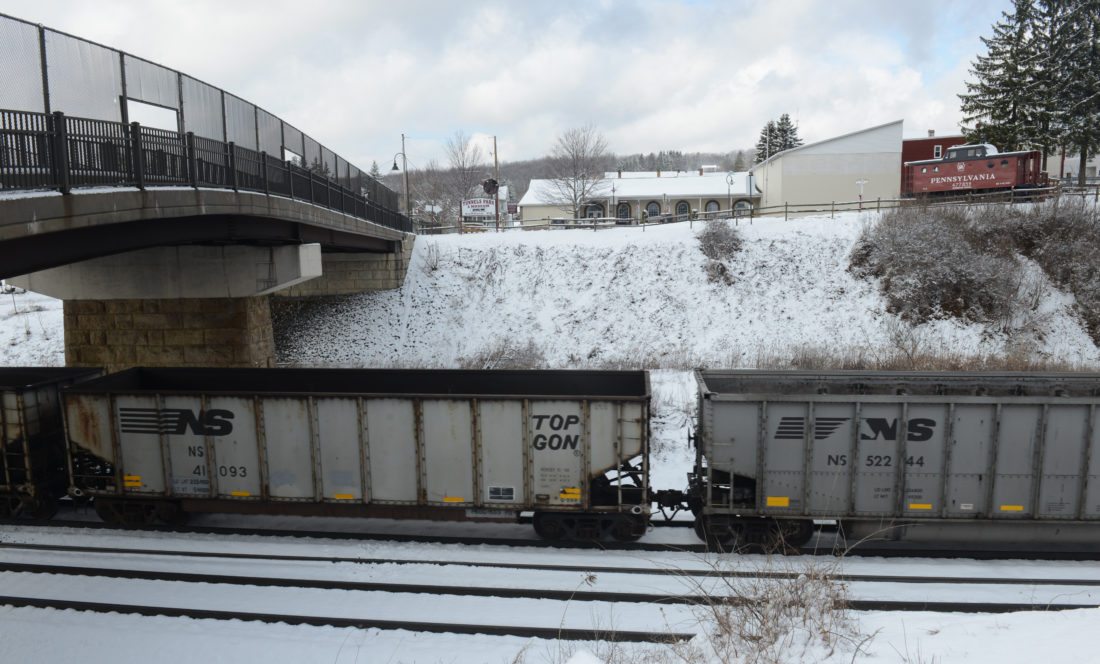
And regular train traffic was a boon for another industry, carrying coal extracted by workers at local mines, Julian said.
Economic boom
The mines and railroad supported one another, and they both supported the town, Julian said.
In addition to steel work in nearby Johnstown, railroad and coal jobs and the incomes they produced led to development in the borough, which once boasted Cambria County's second largest population, Szynal said.
Szynal remembers the Gallitzin of her youth -- a town that sustained clothing, music and grocery stores, as well as restaurants, a newsstand and a theater.
"It was just a bustling little community," she said.
In mid-February, Szynal unlocked a glass door across an entryway from council's chambers in the borough building.
Inside, Szynal, a member of the local tourist council, pointed out relics of Gallitzin's heyday.
The small museum housed photographs, paintings and certificates related to the Pennsylvania Railroad.
Atop a small table, organizers had displayed decades-old equipment that would have been used to dig coal from local mines.
"I can remember seeing the guys walking home," Szynal said. "They'd be all black carrying their buckets."
There were also photographs of the many women and few men who worked at Publix Shirt Corp., a local business that produced name-brand garments.
"Everybody had somebody who worked in the shirt factory," she said.
The small museum, which is open for only a portion of the year, also includes a small theater where a documentary about Gallitzin is shown.
The theater's walls are lined with class photographs from the since-closed Gallitzin High School. Szynal pointed to her image on the wall.
And she spoke about the importance of preserving the artifacts and sharing them with future generations.
"You just don't want to lose that," she said.
The first building block
Gallitzin's residents are familiar with loss.
Instead of department stores, jewelry shops and theaters, residents now have a lone Dollar General.
Instead of high-paying jobs in railroad and coal, most now travel to nearby Altoona or Johnstown for work.
And instead of growth and new construction, many of Gallitzin's roads are lined with chipped paint, tarped roofs and boarded windows.
Szynal attributed the town's downfall to two main factors -- the loss of industrial jobs and the increased rate of automobile ownership that meant residents could more easily travel to out-of-town shops, no longer supporting Gallitzin's own.
"A lot of people say now that the Logan Valley Mall (in Altoona) is our Main Street," Szynal said.
But that doesn't mean the town's current residents have given up hope. That was a message borough Mayor Raymond Osmolinski stressed earlier this year.
In recent years and months, the borough's leaders have made it a priority to update infrastructure, which Osmolinski called the first building block of new development.
People's Natural Gas has expanded into Gallitzin for the first time, a new water system has been implemented and old sewer pipes were replaced.
"The only thing we have to do now is the roads," Osmolinski said.
That work is already beginning to pay off, the mayor said, pointing to a developing area known as Cedar Drive, where modern homes are to be constructed.
Still, Osmolinski did not deny that problems exist within the already built-up parts of the borough.
"We do have a lot of empty houses in town," he said. "There are some bad properties, but we don't have the money to tear these places down."
A link to the past
Those problems have done little to deter Osmolinski's hope that Gallitzin will continue to succeed, he said.
"I've always liked it here," he said. "There's something romantic about it to a lot of people."
Romance is what led couple Robert Elder and Migdalia Salaman from Massachusetts to Gallitzin. Their romance was a love for the community's railroad past.
"I have been a lifelong rail fan," said Elder, who sat in a common room inside the Tunnel Inn, a local bed and breakfast.
The inn sits adjacent to the railroad tracks, and, from its built-on deck, visitors can see the trains shortly after they emerge from one of the famed tunnels.
Elder said he visited the inn for the first time years ago and was delighted by its proximity to the tunnels and other significant railroad sites like the Altoona Curve.
He enjoyed it so much that he offered to buy the business. That deal eventually was approved, and he and Salaman moved to Gallitzin.
"When I came down originally, I fell in love with the tunnels, the trains," Elder said. "I like the small-town atmosphere."
The inn, which offers multiple rooms, is decorated to reflect a railroad theme, and Elder said train enthusiasts from across the country have called to make reservations.
"I'm pleased to be able to bring these folks and what they have to Gallitzin," he said.
The inn isn't the only local business to take advantage of Gallitzin's railroad past. The nearby Iron Horse Bar & Grille takes its name from popular locomotives.
And like the inn, The Wine Cellar, a local restaurant, has a customer base that mostly consists of out-of-towners, the business' owner said in a brief voicemail message.
Looking ahead
Many of those who continue to settle in Gallitzin have an appreciation for its long-standing history and often tout projects like the Cedar Drive development.
"It's a sense of pride for all of us," Julian said. "We're progressing nicely."
Gallitzin's borough building is a testament to that pride, as well as the generosity of the local residents, said John Palko, a former Borough Council member and lifelong resident.
Palko was one of several leaders who proposed that a former screen printing business should be converted into a new borough headquarters.
A local bank helped with the building itself, but all renovations were paid for by community donations, Palko said.
"We raised over $200,000 in order to redo this building," said Palko, who also is an active member of the local Moose. "People in a sense were coming out of the woodwork to help support the project."
Now, the building includes the borough offices, as well as the local library and the small museum.
"It turned out pretty nicely," Palko said.
Borough Councilman Phillip Mazzarese, who owns a local pizza shop, said work is now ongoing to improve area recreation and parks, with plans to construct a walking path around a local athletic field.
And the area continues to be important to the railroad, said Jonathan Glass, a Norfolk Southern spokesman.
The tunnels in Gallitzin are part of one of Norfolk Southern's "most important corridors in terms of customer service and revenue," Glass said.
An average of 40 to 60 Norfolk Southern trains pass through the tunnels per day, carrying items like consumer goods, coal and finished vehicles, he said.
Julian said he anticipates Gallitzin will continue to remain an import part of Cambria County for years to come.
"Gallitzin is a beautiful town. People like each other," Julian said. "I think that's a pretty good attribute for any small town. I take great pride in it."
Mirror Staff Writer Sean Sauro is at 946-7535.
—
Gallitzin Borough
At a glance
Population: 1,668
Median age: 39.7
-- Under 10: 204
-- 10 to 19: 209
-- 20 to 39: 429
-- 40 to 64 : 582
-- 65 to 79: 169
-- 80 and up: 75
Median household income: $32,386
Below poverty level: 10.2 percent
HS graduate or higher: 93.2 percent
Housing units: 149
-- Built 2000 or later: 7
-- Built 1970 to 1999: 33
-- Built 1940 to 1969: 21
-- Built before 1940: 88
Source: Census bureau (2010-16)