
Autism therapy center relocating
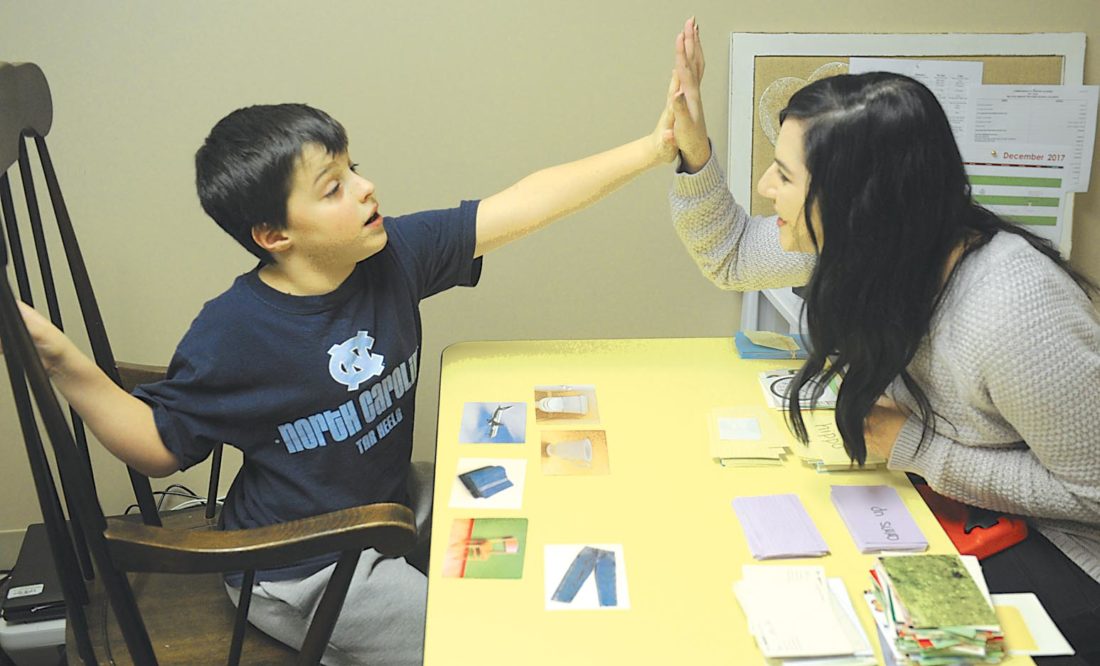
Mirror photo by Gary M. Baranec / Registered Behavioral Technician Tabitha Clowson works with Ryan Finochio, 7, of Hollidaysburg on Wednesday at the Journey Center autism therapy school in Duncansville. The center is moving within the next several months to a building in Garden Heights that formerly housed a Christian bookstore.

Mirror photo by Gary M. Baranec / Registered Behavioral Technician Tabitha Clowson works with Ryan Finochio, 7, of Hollidaysburg on Wednesday at the Journey Center autism therapy school in Duncansville. The center is moving within the next several months to a building in Garden Heights that formerly housed a Christian bookstore.
About 17 years ago, when Kim Bennett was still a speech therapist with the Intermediate Unit 11, she worked with Jacob, a preschool 5-year-old with autism who banged his head against walls, attacked staffers and crawled under tables.
Jacob couldn’t speak or otherwise communicate, but Bennett tried to teach him sign language, hour after hour and day after day for two years, using pictures and — because he liked to eat them — cheese curls to get him to respond.
Frustrated, Bennett asked a mentor how long it was supposed to take, and her mentor replied, “keep it up.”
Not long after that, her daily contact with Jacob ended, as Bennett was promoted to educational consultant and began further study on the treatment of autism.
Two years later, she encountered Jacob in a kindergarten class, where another therapist was showing him a cheese curl, as Bennett had done so many times herself.
Then she witnessed an epiphany as, for the first time ever, Jacob responded — repeating back to the therapist the sign for that orange-colored snack food.
Bennett’s face transformed as she recalled the “Helen Keller moment” — and the boy’s face transforming, when he realized what he had done.
“Something clicked,” Bennett said. “He got it.”
The moment suffused Jacob with confidence, and he sat back — “lounged back,” Bennett remembers — and began signing for one thing after another, as his excited therapist held them up for him to see.
“I felt like a mom whose kid just said his first word,” Bennett said last week in the Duncansville location of the autism therapy service she founded in 2014 to help children like Jacob.
Moving to new building
It’s a small building, and she’s moving within the next several months to a building in Garden Heights that formerly housed a Christian bookstore.
The Altoona Planning Commission recently approved the land development plan for the building, located behind Wendy’s on Plank Road.
A couple of days after the Planning Commission meeting, 7-year-old Ryan Finochio of Hollidaysburg was sitting at a desk in a small room at the Duncansville center in front of registered behavior technician Tabitha Clowson, who was showing him a succession of small flashcards that she pulled from several piles on the desk.
In one pile were “tact” or contact cards, showing objects that can be touched, like “apple.”
In another pile were “motor imitation cards,” showing actions that one can perform, like “clap.”
A third pile included “echoics,” indicating sounds that one can make, like “b-u.”
And a fourth featured “target” cards, which are new to Ryan, and that he hadn’t mastered yet.
When shown the cards, Ryan responded verbally if he could, by sign if he had to if he didn’t know the word.
When he answered correctly, Clowson rewarded him with a high five, a brief look at his iPad or a small piece of candy.
When he answered incorrectly, she would give him the right answer, and he would repeat it.
Ryan, whose intellectual skills are now at the level of a 5-year-old, can identify the pictures on more than 280 of the cards, Bennett said.
Every several cards or so, Clowson “reinforced” the efforts of the boy with a small piece of candy or by handing him his beloved electronic-screen “assistive device.”
Without such reinforcement, Ryan would grow frustrated, Clowson said.
Even with the reinforcements, he sometimes flaps his hands, holds a finger to each ear or chews on the front of his T-shirt collar.
Periodically, they take breaks and leave the room.
The card exercises mesh with other activities at the center.
If the therapist is showing cards with reindeer, she also may read stories about Santa and his reindeer, followed by paper cutout sessions making those same reindeer.
Sometimes it takes many such “trials” before an idea fixes itself into the mind of a person with autism, according to Bennett.
Charting progress
The center is fanatical about charting progress, according to Bennett.
“We monitor everything,” she said.
Speaking only gibberish like a toddler when he came to the center three years ago, Ryan can say words, phrases, even full sentences at times and is starting to read, said his mother, Joy Finochio.
“It’s been an amazing three years,” she said.
Bennett, who has certifications from Indiana University of Pennsylvania and Penn State University and a master of education degree from Saint Francis University, uses Applied Behavior Analysis, a research-based treatment strategy that is “at the forefront of therapeutic and educational interventions for children with autism,” according to the Center for Autism and Related Disorders (CARD).
With ABA, therapists try to manage and mold the behavior of subjects with tactics that include rewards for positive behavior, elimination of problematic environmental triggers and the teaching of coping skills, according to the Autism Support Network.
Therapists identify problematic behavior, design “interventions,” monitor results and adjust interventions to ensure continued progress, according to CARD.
ABA can help people with autism improve their language and social skills, reading, math and life skills, Bennett said.
One in 68 have autism
The range of issues caused by autism, which is caused by neurological irregularities, is broad.
“No one knows the cause or cure,” Finochio said.
One in 68 children have autism — and one in 42 boys, in whom it’s five times more common, Finochio said.
And no two are the same, she said.
Some people with autism are brilliant, with mathematical capabilities far beyond the norm or photographic memories, according to Finochio and Bennett.
Others can’t be potty-trained, Finochio said.
Generally, people with autism tend to be literal and to focus on the specific and the concrete, Bennett said.
They have difficulty with abstract, metaphorical concepts.
They don’t understand how someone could be “sweet,” for example, Bennett said.
Many people with autism don’t like change, according to Bennett.
When they encounter the unexpected, many become confused and overwhelmed, she said.
They tend to say what they think, regardless of its effect on others, she said.
They also may be either over- or under-sensitive to stimuli like pressure, heat, noise or light, according to Bennett.
A former student of one of Bennett’s former professors said he could hear the flutter of butterfly wings.
A woman whom Bennett met at a conference once pressed a hot iron onto her forearm so she could feel the sensation of heat — and bore the scar to prove it.
Ryan Finochio craves “deep pressure,” in the form of “tickles, rubs and squeezes,” his mother said.
But some kids with autism don’t even like to be touched, she said.
One-on-one instruction
Finochio pulled Ryan out of the Hollidaysburg Area schools in favor of the Journey Center not because she was displeased with the care in school — his personal aide was great — but because it was an opportunity for one-on-one instruction from a teacher, Finochio said.
To do so, she enrolled him in cyber school.
Cyber schools are obligated to provide special education, but lack brick-and-mortar buildings, and so contract with services like hers, according to Bennett.
The cyber schools pay her company, and they in turn receive reimbursement from clients’ home public school districts.
Most kids get four hours of therapy a day through the charter schools, according to Bennett.
Some get five or six hours, she said.
Private insurance may pay for the second half of a day’s therapy, according to Bennett.
In recent months, she has been able to take children with Medicaid coverage.
She also provides therapy as a visitor to public schools, having worked with the Central Cambria School District.
That began when she provided help in creating a plan for an autistic student, and it has continued with training for district teachers and others on data collection and assessment, according to Melissa Shaffer, Central Cambria’s special education director.
At Central Cambria, Bennett showed how to make “difficult interactions with students easier,” Shaffer said.
It helps that “she is not easily frustrated,” Shaffer said.
Bennett also provides therapy to children in their homes in several counties in the region.
An area school that specializes in autism takes some of the more difficult cases that neither the school districts nor the Journey Center are equipped to handle, according to Bennett.
Founding the Journey Center
Bennett founded the Journey Center after a conversation with her boss at the IU triggered by a student kicking Bennett in the head.
The organization needed to do more for students with autism, Bennett said, repeating something she’d said many times before.
“Kimberly, you can’t save the world,” her boss said. “Maybe you better start your own thing.”
So she did.
The proposed new location on the 100 block of Byron Avenue in Garden Heights is ideal because, while it’s not busy, it’s close to the busy commercial strip, according to Bennett.
It will be safe for drop offs and pickups, but just a short walk to Wendy’s and McDonald’s restaurants, where staffers can take clients for socialization, she said.
Working with clients in restaurants can bring good results, she said.
She worked with one boy in the State College area whose family couldn’t take him out because he would cry, flap his hands and make random noises, drawing unwanted attention.
Bennett began by taking the family to a Chinese restaurant with an accommodating staff during off-hours when there were few other diners, bringing familiar foods at first, letting the boy play with his iPad, then working up to less familiar foods served by the restaurant and busier times.
He gradually calmed down and became accustomed to the routine, and that calm transferred to other situations, so that the family eventually could take the boy to church picnics and even concerts.
“He started to learn how to act appropriately in public,” Bennett said.
At one point, the boy’s mother called in tears, thrilled that her family was able to attend a movie with their son.
‘I love you this much’
The 6,000-square-foot, two-story building in Garden Heights is more than twice as big as the cramped location in Duncansville, so that the center can accept additional clients, Bennett said.
Workers will remodel to create treatment rooms for individual therapy sessions, new bathrooms, a “sensory room” where kids can run, jump and ride bikes, Bennett said.
Extensive accessibility work is also required.
She hopes to move in a couple of months.
Bennett also operates the Journey Center in Bellefonte.
The first child with autism that Bennett ever encountered was Nathan, whom she met while still employed by the IU. Nathan’s mother confided sadly that she didn’t think she’d ever hear her son say “I love you.” So Bennett went to work with a children’s book titled “Guess How Much I Love You,” which included a picture of a mother rabbit with her “arms” wide, saying to her child, “I love you this much!”
Eventually, when Nathan was ready, Bennett copied a picture of the mother rabbit from the book, sealed it in an envelope with instructions to open at bedtime and show to Nathan.
He took it home, and his mother that night did as instructed. Nathan responded as Bennett had taught him, saying, “I love you this much!” Nathan’s mother was crying when she called to thank Bennett for what she had done.
Mirror Staff Writer William Kibler is at 949-7038.
Local News
Agency OKs data center water permit
The building of a hyperscale data center in northeast Pennsylvania hit a milestone earlier this month with an ...
State funds could help Altoona Area School District with $3.8M budget shortfall
The Altoona Area School District’s 2026-27 preliminary budget projects a $3.8 million shortfall, which could be ...
Catch and release
Lower Trail’s Alfarata trailhead near Alexandria expected to reopen
Blair County Prison inmate seeks credit for time served
An inmate presently in the Blair County Prison has filed a petition with the United States District Court in ...
Four Maryland residents arrested after alleged robbery in Microtel parking lot
Four Maryland residents are behind bars after allegedly robbing two people at gunpoint in a hotel parking lot ...