
Logan Township officers prepare to use body cameras
Police departments must navigate state wiretapping laws
Trending
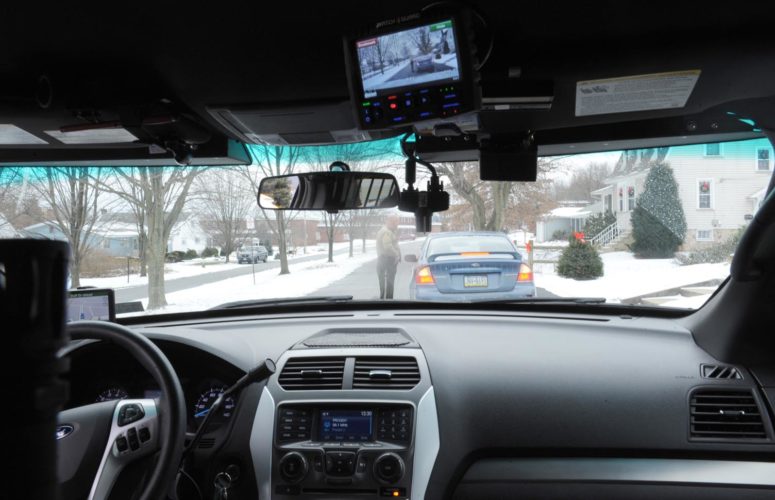
Mirror photo by Gary M. Baranec / A Logan Township police officer talks to a driver during a pullover on Friday. Logan Township police are planning to have officers wear body cameras starting in January or February, in addition to their in-car cameras (shown above).
Early next year, when some police in Blair County hit the streets, they'll have a new kind of backup when they step out of their vehicles.
Logan Township police are planning to have officers wear body cameras starting in January or February, and Police Chief Tim Mercer said the technology will go hand-in-hand with the in-car cameras added to the department's fleet earlier this year that have so far proved to be an effective tool.
"It is very good. The evidence we're collecting to help and bolster our cases is fantastic," Mercer said of the in-car cameras, which include a wireless microphone that officers wear.
With the cameras will come some added responsibilities for officers to safely navigate the state's wiretapping laws, but Mercer said officers will be trained on the new departmental policy regarding the use of the cameras.
Because Pennsylvania is a two-party consent state, officers will have to turn off their cameras when they enter a private residence, Mercer said, adding that he would like to see the Legislature address the issue to give police exemptions.
In October, the Senate passed an amendment to the state's wiretap law that would mean officers could wear the cameras inside private homes without getting consent, but the House measure to address the issue never left committee.
Mercer said one scenario officers often encounter is an active domestic dispute call where officers may arrive at a home to find a violent and chaotic situation, and especially if it's one where people are moving in and out of a home, getting consent is difficult or impossible. Then you are left with an officer who has to take his or her attention away from the surroundings and remember to switch off a camera before entering a home.
If the situation moves outdoors and the officer forgets to turn on the camera, then they are inviting criticism because people will say it was not turned on because the officer was trying to hide something, Mercer said.
"I would love to see the wiretap law changed so you could record every police incident," Mercer said. "I think it enhances transparency."
The Senate amendment also included provisions that made it tougher for the public to access body camera footage, which has invited criticism from civil liberties groups such as the ACLU.
State Rep. John McGinnis, R-Altoona, said he would support changing the wiretap law to give police the ability to use the cameras more, and he said it is reasonable that public access be limited while still making the footage available for court proceedings, whether criminal or civil complaints against the police.
"I can understand the ACLU on one hand," McGinnis said of the concerns that unfavorable footage of police would not see the light of day. "On the other hand, this might be a great way to protect people's rights against abuse."
McGinnis explained that, with citizens shooting video of police, often in incomplete segments that tell only part of the story, the use of body cameras could be a way to have a complete record of an incident.
It would be like any other evidence, McGinnis said, and could either support what police allege or support a citizen's version. Either way, the footage shouldn't be something the public should easily access to protect both police and the people they encounter.
"You don't open these up for public view," McGinnis said.
Defense Attorney Dan Kiss pointed out that the cameras "have their ups and downs."
"It will certainly cut down on the claims of abuse," Kiss said. "If it does occur, you have a smoking gun."
Kiss said he wasn't certain that officers responding to an incident inside a private home would actually be violating the wiretap law if they were called to the scene and given the stance that police interaction is not considered a private conversation.
It does raise questions about Fifth Amendment rights against self incrimination, though.
"That question has not been answered," Kiss said, noting that just as arguments arise now about Miranda warnings and whether statements can be used in court, he foresees questions on police encounters with people when body cameras are recording.
If a person says something incriminating during a mere encounter with police, can that be used against them? It also raises questions on what becomes of the footage after an encounter with no case.
"If there is an encounter with police with John Q. Public and there are no charges filed -- is that evidence?" Kiss said of the footage captured. "That's the shaky side of it."
Overall, he said it will definitely make police encounters more transparent and can provide important evidence should a case or complaint against an officer go to court.
Kiss pointed to former Altoona police Officer Mark Sprouse's case, one where he was acquitted of assaulting a man in custody, but only after much publicity and after losing his job.
"Had he been wearing a body camera, we would have seen everything, and he would never have been charged," Kiss pointed out.
Kiss also said that an officer's job isn't easy. It's physical and not G-rated, so the public viewing the often gritty, sometimes profane and often physical world of law enforcement would change people's perceptions of police, for good and bad.
Jim Ott, Duncansville police chief, said for a small department, the body cameras aren't a high priority at the moment, but it is something he sees one day being a requisite piece of equipment.
"The take on things is, if it's not on tape, they don't want to believe the officers," Ott said, noting what he said he sees as a shifting public perception that has made it so police have to possess something to back up their accounts of incidents.
"It's a shame," Ott said.
While he thinks the body cameras also help police, Ott said he can't help but take it personally at some level that, as an officer who took an oath to enforce the law in a "fair, equal and impartial" manner, the police's word seemingly holds less weight than it once did. He took an oath, and he said his word has to mean something.
Ott said he gets that, like any profession, there are officers who abuse their power, but he argued it's a small percentage compared to the majority of men and women in law enforcement who go out everyday and serve with integrity and honesty.
Professionally, he sees the benefits.
"If you're not doing something wrong, it's going to be your best friend," Ott said.
Duncansville police have had in-car cameras with microphones for officers since 2012, and Ott said it has helped the department. Still, with tight budgets, buying body cameras means not buying or upgrading other necessary pieces of equipment. Ott agreed, however, that the move is toward the cameras and said it's important the state's laws are addressed so police can effectively employ the devices.
Mercer said each camera, which will sync with the in-car cameras to provide linked views of the same incidents, cost about $1,000, with $500 for upgrades for each of the township's patrol vehicles, along with a $1,500 docking station to charge and sync the cameras between shifts.
Mercer said the department waited to get the body cameras to make sure the technology could integrate with both the vehicle and body cameras and because he wanted the officers to be proficient at using the cameras on the vehicles.
Logan Township police want to be the leaders in the state with this type of technology, Mercer said, and officers have been extremely receptive to the vehicle and body cameras. The technology will make the department more transparent while helping gather important evidence, he stressed.
While technology of police work is always changing and requires a lot of training, Mercer pointed out that it also provides so many benefits to the officers -- who already use video from surveillance cameras in the course of their everyday investigations.