
School districts weigh pros, cons of artificial surfaces for athletics
Trending
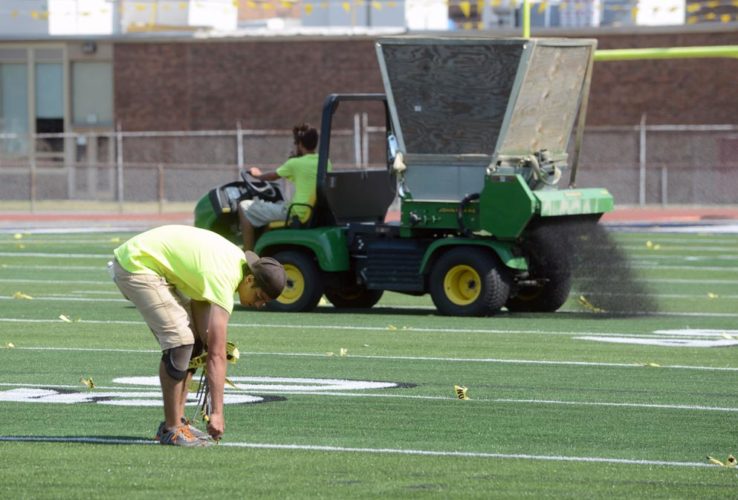
Mirror file photo by Patrick Waksmunski / Employees from TPK Inc., Allison Park, work on the turf at Hollidaysburg Area School District's Tiger Stadium in August. More than a quarter century ago, artificial turf first made its way onto a Blair County field following a vote from the then-Altoona Area School Board to install it at Mansion Park Stadium.
Often, many months will pass without a single word spoken during Tyrone Area School Board's public comment period, but that wasn't the case only a few months ago, when about a dozen parents gathered to voice concerns.
Among them, one man spoke, describing the issue in basic terms.
"When you're a kid, you dream about playing there," local resident Kerry Naylor said, talking about Gray-Veterans Memorial Field, where football is played on a deteriorating surface.
To some, including Naylor, the clear fix for its uneven surface and drainage problems is installing artificial turf.
"We are saying, 'Look, the turf is so bad that you can't fix it at this point,'" Naylor said last week.
But while several area districts have seen artificial turf as an investment and community asset, others have found it difficult to justify the expense, which is often well over half a million dollars.
"It's a big investment. It's a huge investment," Tyrone board member James Raabe said in September. "We are looking at the education of students. That's our No. 1 goal."
'At least look into it'
Second to improving field conditions, inclusion is the driving factor motivating Naylor, who's been advocating for artificial turf for months.
Following an inspection this spring by a Penn State Extension commercial horticulture educator, the number of games played on Gray Field was drastically decreased to protect the field's surface.
In May, Tom Muir, the district's physical plant supervisor, said the number of games played on the field would be reduced by more than 50 percent, allowing only about 20 games.
"I don't like that; I don't want that, and it's not right," Naylor said of what he described as exclusion.
Naylor has said he hopes a more durable, artificial surface will allow other sports, not just football, to be played on the field.
"It's the better option because you could use it for multi-purpose," he said, listing soccer and band competitions as artificial turf beneficiaries.
That's an opinion Naylor has voiced to Tyrone Area School Board members several times.
"I've gone to them several times and said, 'Could you please just look into this?' And they've never looked," Naylor said.
Those requests seemed to come to a climax in September, when about a dozen concerned parents attended a board meeting, pointing out field deficiencies for more than an hour.
Following the contentious discussion, board President James Crawford said only that board members would take concerns "under consideration."
Last week, board members heard from a natural grass turf expert, who presented a $299,000 plan to completely renovate Gray Field.
The renovation would include leveling the surface and covering it with sod, as well as installing drainage and irrigation systems.
Board members did not vote on whether or not to go to with a natural option.
Naylor wasn't at last week's meeting, and said he has two questions he'd like answered.
"Are they going to continue to maintain it throughout the year?" he said.
At the meeting, Muir presented a maintenance plan, which included regular care.
"Are you going to open it up for everybody else?" Naylor asked.
That seems unlikely, as Muir and board members talked back and forth at the meeting, saying at times that Gray Field is too small to accommodate soccer.
So far, there has been no presentation about artificial turf.
However, Muir previously estimated turf installation at Gray Field at a cost of more than $1 million, with thousands of dollars in maintenance needed each year.
It would cost considerably more than maintaining natural grass, he said.
In contrast, Naylor claims he's spoken with experts who put the cost below $1 million -- a price he said could be covered by the Tyrone district, which he said is in good financial standing.
And Naylor isn't asking board members to act on his word alone.
"Do a feasibility study. At least look into it," he said. "I would like long-term projections.
"How much money are you going to sink into it in year two? How much money are you going to sink into it in year three? And how many other sports are going to play on it?"
'It's like New York City'
More than a quarter century ago, artificial turf first made its way onto a Blair County field following a vote from the then-Altoona Area School Board.
A Mirror report from that time shows the Altoona district then faced similar drainage issues to those in modern-day Tyrone.
In September 1989, the first game on artificial turf was played at Altoona's Mansion Park Stadium.
Invitations to the opening game were sent to numerous local officials, but the $355,000 surface faced opposition even then.
John Ebersole -- an Altoona high school football standout, who went on to play at Penn State and for the New York Jets -- was among the naysayers, according to a 1989 Mirror report.
"Eventually, (from the weather), it will become hard and abrasive," Ebersole told the Mirror at that time.
However, Phil Riccio, Altoona Area's current athletic director, had nothing but good things to say about artificial turf last week.
"The artificial turf is the greatest way to go," he said. "And it pays for itself over time."
Inclement weather and heavy use can severely damage natural grass fields. Riccio said that's not the case with artificial.
"The surface isn't going to go bad like you have with grass," he said, explaining the Mansion Park field is in almost "constant" use. "You never have to cancel a game because of weather."
Sporting events, gym classes and community outings were among the activities Riccio listed for the field.
"Everybody gets to use it," he said. "It's like New York City -- it never sleeps. You couldn't play that many games on grass fields."
Riccio cited other benefits, including less field maintenance. And, for parents, it means less time spent trying to get grass and mud stains out of uniforms, he said.
Eventually, Altoona Area elected to have artificial turf installed on two additional fields -- Roosevelt Athletic Field and the district intramural field, both between the middle and high schools.
Typically, an artificial surface can be used for 10 years before being replaced, Riccio said.
In 1999, 10 years after the turf's installation at Mansion Park, Altoona Area School Board members first considered the turf's replacement, with the district's then-spokesman estimating a new surface would cost several hundred thousand dollars.
Turf prices had already risen "steeply" since the installation a decade earlier, the Mirror reported.
Today, when turf replacement projects are put out to bid, they typically receive a price tag of about $300,000, Riccio said.
'Why let it sit there?'
This summer in Hollidaysburg, the cost of replacement was more than half a million dollars, Hollidaysburg Area Athletic Director Homer DeLattre said. The exact cost was $542,000.
That figure is more than half the price of the original turf installation at Tiger Stadium -- a cost of $850,000 in 2004.
In all, Hollidaysburg's artificial surface lasted 12 years and 11 seasons, DeLattre said.
Modern turf surfaces, he said, can last up to 14 years.
"There's very little cost in maintaining it," he said, explaining a vacuum-like machine is sometimes used to clean its surface.
Despite the seemingly high replacement expense, DeLattre said artificial turf is "a great benefit to our school district and our community."
This fall, the field accommodated 48 individual events, DeLattre said, listing the numerous sports teams, as well as the district's band, that use its surface.
And when it's not used for official school functions, the field is opened to the public, he said.
"It's good for the community to come and use at their convenience," DeLattre said, imagining games of catch between fathers and sons and friends tossing a Frisbee.
That level of use, DeLattre said, would not be possible with a natural grass surface, which requires regular care and maintenance.
"With a grass field, you are limiting your usage," he said. "A lot of the fields are used for five Friday night football games, and that's it."
Maintaining a facility to host only a small number of games is not cost effective, DeLattre said.
"They're paying for a facility. Why let it sit there?" he said.
Because of the artificial surface, Tiger Stadium can be rented year-round by community groups and for sporting events, such as playoffs and finals, DeLattre said. Those rentals, which require a fee, mean added revenue, he said.
"We wouldn't be able to have those things if we had a grass field," DeLattre said.
'That was really cost prohibitive'
But Hollidaysburg Area School Board didn't vote to shell out the original $850,000 for artificial turf.
Area businessman Shawn McCarl led the effort and amassed funds to cover the large cost, according to a Mirror report from last year.
A subsequent article quoted former Hollidaysburg Area School Board member Kirk Dodson, the only member to vote against artificial turf installation.
"I said a day will come when there won't be a benefactor, and taxpayers will be left holding the bag," he said.
That seems true, at least for now, as the $542,000 turf replacement was completed in August, and will be paid for with capital reserve funds unless money can be raised through the district's "Restore the Roar" capital campaign.
The large price tag for artificial turf seemed a bad choice in Central Cambria School District, where administrators recently chose a different option, Superintendent Vincent DiLeo said.
Upgrades to the district's varsity football field aren't needed, as it's in good condition, but artificial turf was among three options considered for a new multi-purpose field, DiLeo said.
According to estimates, artificial turf would have cost Central Cambria between $1.5 and $2 million, he said.
"On top of that, we would have to add to our budget at least $60,000 to $80,000 per year," DiLeo said. "That was really cost prohibitive in the board's eyes.
"That was something the board really wasn't in favor of, and I agreed with them."
The board found that a sod method, similar to the one presented in Tyrone, was also too costly, DiLeo said.
Eventually, board members voted to pay $244,000 to apply top soil and grass seed to the new field, which DiLeo said is intended to "take some pressure off our main football field."
Grass, he said, is already growing on the field.
"It looks great. The hope is that by the fall it will be able to be lined and played," DiLeo said. "It makes a nice addition to our campus up there."
Mirror Staff Writer Sean Sauro is at 946-7535.