
Most Americans think AI developing too fast
Trending
Worries around artificial intelligence cross party lines, with the vast majority of Americans saying the U.S. government should prioritize keeping AI under human control and protecting workers.
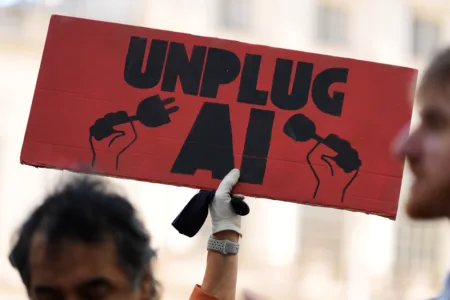
A new poll from The Associated Press-NORC Center for Public Affairs Research finds that most Americans, 64%, think AI is developing "too fast," while 27% say its development has been "about right" and only 8% say it's moving "too slow."
The risk that powerful AI models could evade human control and hurt humanity, once the stuff of science fiction, has been emerging as a more pressing concern. Even leaders of the companies that are developing frontier AI models are calling for a slowdown so that government regulation can catch up. President Donald Trump has pushed back against slowing down AI development because of concerns that China will gain an advantage with the technology. Data centers powering AI projects have also taken a prominent role in major political races as the midterm elections approach.
About 8 in 10 U.S. adults say it's "extremely" or "very" important for the U.S. government to ensure that AI stays under human control, and they are about as likely to want the government to prioritize protecting the country's workforce. Most U.S. adults also think minimizing environmental harm and growing the U.S. economy are highly important. About half say this about promoting technological innovation, and slightly fewer say that about competing with China.
There's bipartisan concern about the speed of AI's development, but few Americans think either major political party has an advantage in handling artificial intelligence. Trump, a Republican, also gets a low rating on his handling of the issue, with 67% of U.S. adults disapproving of his performance on AI.
Stephanie Stewart, a junior-high science teacher in Sunset, Utah, said she is frustrated by the president's opposition to AI regulation.
"There is no handling of the issue except for we're just going to allow these companies to do whatever they want, and we're not going to regulate them," said Stewart, 53.
Protecting workers should be priority
Ron Theusch, a truck driver who lives in rural Alden, Minnesota, said his No. 1 concern with AI is the potential loss of jobs -- including his own.
"I can just see a train of self-driving trucks 24/7, just running up and down I-35, loading and unloading. I can just see that happening," said Theusch, 58.
Most Democrats and Republicans agree on the importance of protecting workers and keeping AI under human control, the poll found.
"There was a movie called 'Terminator,' where the robots came back and killed everybody," Theusch said. "People relate to that … I don't know where it's going to land. I really don't have anything I can do to control it, you know. It's going to evolve."
There's less consensus about the importance of other priorities when it comes to AI. Republicans are more likely than Democrats to say it's highly important to grow the U.S. economy and to compete with other countries like China. Democrats, on the other hand, are more likely to say it's at least "very" important to minimize environmental harm.
"I don't understand how, because they're doing something as well as us, that we can't be more human about it and more humane about it than just to say, 'Well, they're doing it, so we have to do it,'" Stewart said of U.S. competition with China.
And while about three-quarters of Democrats say AI is developing "too fast," only about half of Republicans share that worry. People under 30 years old also express higher levels of concern than people 60 or older, the survey found.
"I think I have all the normal concerns, right? I think it's wonderful for certain applications, but I also feel like it will be overused and can create a lack of personal connections. It can make people lazy because information is just given to them without really having to research things on their own," said Kelly Opp, a 62-year-old Republican in Albuquerque, New Mexico.