
Heads of AI firms raise alarm at United Nations
Trending
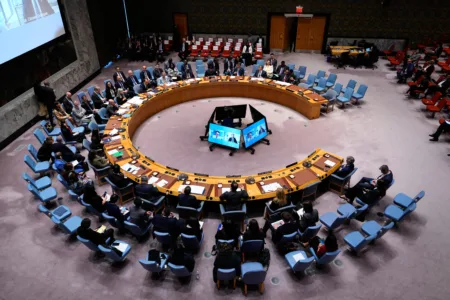
The heads of major artificial intelligence firms pleaded with the United Nations on Wednesday to save the world or at least its people -- in the form of somehow regulating the burgeoning technology that they have been designing.
"If managed poorly, I even believe AI could be a risk to humanity as a whole," said Dario Amodei, chief executive officer of Anthropic. And from his competitor Sam Altman, CEO of OpenAI, came this assessment: "We could lose control of the future to AI."
Both said the countries of the world, through the U.N. Security Council, where they testified Wednesday, have to set safeguards of some kind, which would be actual controls to prevent the technology from getting too powerful to rein in.
They also called for the world to make sure that the power of AI isn't concentrated in one company or country. They said that as they also touted the benefits of the technology for bettering humanity and what Altman called "giving people more power over their own lives."
Those tech leaders "are telling us in stark terms that it cannot be left to them to prevent disaster from befalling the world," said United Kingdom Foreign Secretary Ed Miliband said at the Security Council. "We cannot ignore them because they are right.''
AI at the heart of G20 discussions
Miliband said when the U.K. takes control of the G20 next year it will put controlling AI at the heart of discussions, looking for a single set of global standards "to insure that AI development is safe."
But the United States said don't do it.
Worries about control of AI are "not a reason to pause its further development or to constrain it with new global governance structure," said White House Science Adviser Michael Kratsios. "We want you, our allies and partners, to share in the benefits of this technology."
For most of the world leaders, along with California Governor Gavin Newsom in New York for climate discussions, one of the key questions about AI is this: Who should control life-and-death decisions -- human or machine?
Amodei, Altman and Hugging Face CEO Clement Delangue, who spoke via a glitchy remote connection, spoke with the U.N.'s most powerful council because they and world leaders are trying to figure out not just whether to control AI, but by who, how it could possibly be done and when it might be just too late.
The day before, U.N. Secretary-General Antonio Guterres warned of "killer robots." Experts and European leaders said that's not hyperbole but something that's either already a grim reality or perilously close.
Amodei called on the nations of the world to agree on not letting AI build biological weapons, figure out how to verify what models have the capability to do and "establish common standards" for testing and for loss of control and misuse.
French Foreign Minister Jean-Noel Barrot, whose country convened Wednesday's meeting and has fostered various other coalitions and discussions about AI, compared the current state of it to both the runaway computer HAL9000 in the movie "2001: A Space Odyssey" and the dawn of the atomic age.
"Just as with the atom back then, the international community must now regulate AI in order to make the most of its potential and avoid the worst," Barrot said.
Other nations paying close attention to AI
His wasn't the only concern expressed during this high-profile U.N. meeting week.
Ukrainian President Volodymyr Zelenskyy, speaking at the General Assembly, said some kind of human control over machines must achieved soon. Otherwise, he said, for his country it may be just too late.
"There is already a real possibility that AI, not only people, will begin to decide what happens on the battlefield. And we need peace before we reach that point," Zelenskyy said.
Last month, a Russian drone seemingly using AI "autonomously made a targeting decision that killed three Ukrainians. Killer robots are technically easy to build, and they are real. We should not be under any illusions otherwise," said Kentaro Toyama, an information technology professor at the University of Michigan.