Iran threatens to close Strait
Announcement comes after Trump targeted power plants in Truth Social posts
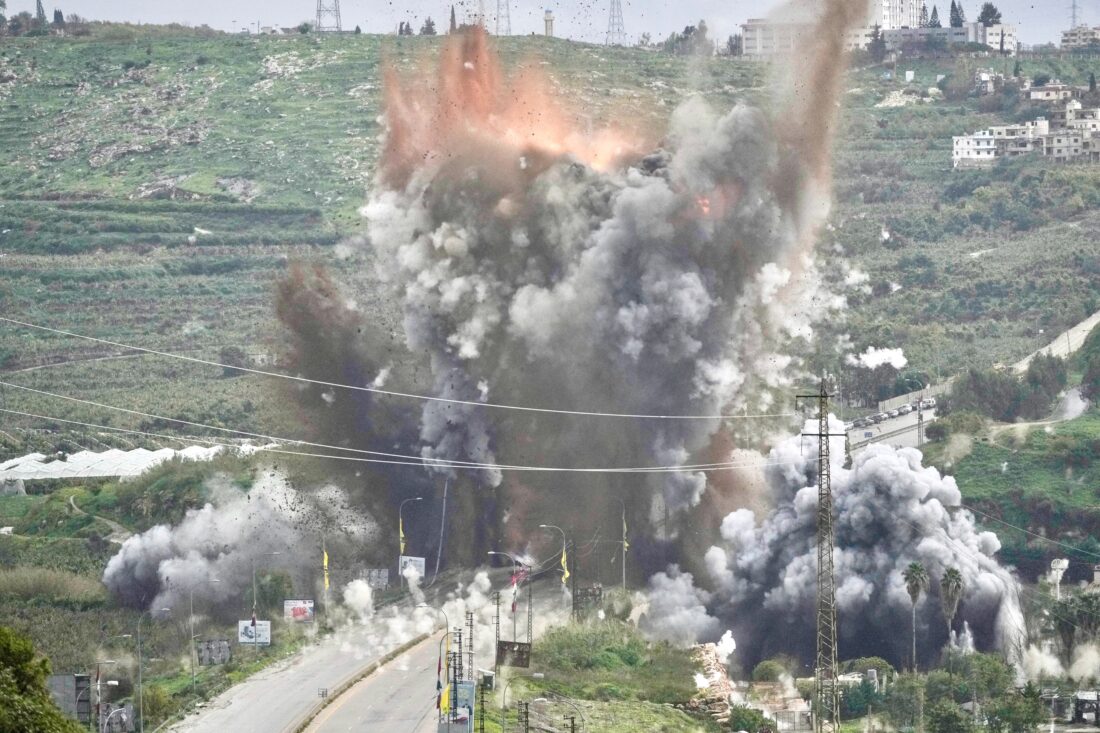
The Associated Press / Smoke and flames rise Sunday from an Israeli airstrike that hit the Qasmiyeh Bridge near the coastal city of Tyre, Lebanon.
ARAD, Israel — The United States and Iran threatened to target critical infrastructure Sunday as the war in the Middle East, now in its fourth week, puts lives and livelihoods at risk throughout the region.
Iran said the Strait of Hormuz, crucial to oil and other exports, would be “completely closed” immediately if the U.S. follows up on President Donald Trump’s threat to attack its power plants. Trump late Saturday set a 48-hour deadline to open the strait.
Israeli leaders visited one of two southern communities near a secretive nuclear research site struck by Iranian missiles late Saturday, with scores of people wounded. Prime Minister Benjamin Netanyahu said it was a “miracle” no one was killed.
Netanyahu claimed Israel and the U.S. were well on their way to achieving their war goals. The aims have ranged from weakening Iran’s nuclear program, missile program and support for armed proxies to enabling the Iranian people to overthrow the theocracy.
There has been no sign of an uprising, nor of an end to the fighting that has shaken the global economy, sent oil prices surging and endangered some of the world’s busiest air corridors. The war, which the U.S. and Israel launched Feb. 28, has killed more than 2,000 people.
The Iranian-backed Hezbollah claimed responsibility for an airstrike that killed a man in northern Israel, while Lebanese President Joseph Aoun called Israel’s new targeting of bridges in the south “a prelude to a ground invasion.”
“More weeks of fighting against Iran and Hezbollah are expected for us,” said Israeli military spokesperson Brig. Gen. Effie Defrin.
Meanwhile, Kuwait and the United Arab Emirates said early Monday their air defenses were dealing with missile and drone attacks as air raid sirens sounded in Bahrain.
Energy and desalination plants are threatened
Iran has effectively closed the Strait of Hormuz that connects the Persian Gulf to the rest of the world, while claiming safe passage for vessels from countries other than its enemies. Roughly one-fifth of global oil supply passes through it, but attacks on ships have stopped nearly all tanker traffic.
Trump said if Iran didn’t open the strait, the U.S. would destroy its “various POWER PLANTS, STARTING WITH THE BIGGEST ONE FIRST!”
The U.S. has argued that Iran’s Revolutionary Guard controls much of the country’s infrastructure and uses it to power the war effort. Under international law, power plants that benefit civilians can be targeted only if the military advantage outweighs the suffering it causes them, legal scholars say.
Iranian parliament speaker Mohammad Bagher Qalibaf responded on X that if Iran’s power plants and infrastructure are targeted, then vital infrastructure across the region — including energy and desalination facilities critical for drinking water in Gulf nations — would be considered legitimate targets and “irreversibly destroyed.”
Qalibaf later added that “entities that finance the US military budget are legitimate targets.”
Attacks on power plants would be “inherently indiscriminate and clearly disproportionate” and a war crime, Iran’s U.N. ambassador wrote to the Security Council, according to the state-run IRNA news agency.
Iran said its strikes in the Negev Desert late Saturday were in retaliation for the latest attack on Iran’s main nuclear enrichment site in Natanz, according to state-run media.
Tehran praised its attack as a show of strength, even as Israel’s military asserts that Iranian missile launches have decreased since the war began.
Southern Israel’s main hospital received at least 175 wounded from Arad and Dimona, deputy director Roy Kessous told The Associated Press.
Israel is widely believed to possess nuclear weapons, though it doesn’t confirm or deny their existence.
National News

Dachshunds continue rise in popularity across US
Daily briefing
Nation Maryland Trump installs Columbus statue ANNAPOLIS — A statue of Christopher Columbus has been ...
Iran threatens to close Strait
Gas prices cancel out increased tax refund
WASHINGTON — The U.S. economy was supposed to start the year with a bang, fueled by an unusually large jump in ...

Former FBI Director Mueller dies