Venezuela’s acting leader signs oil industry revamp
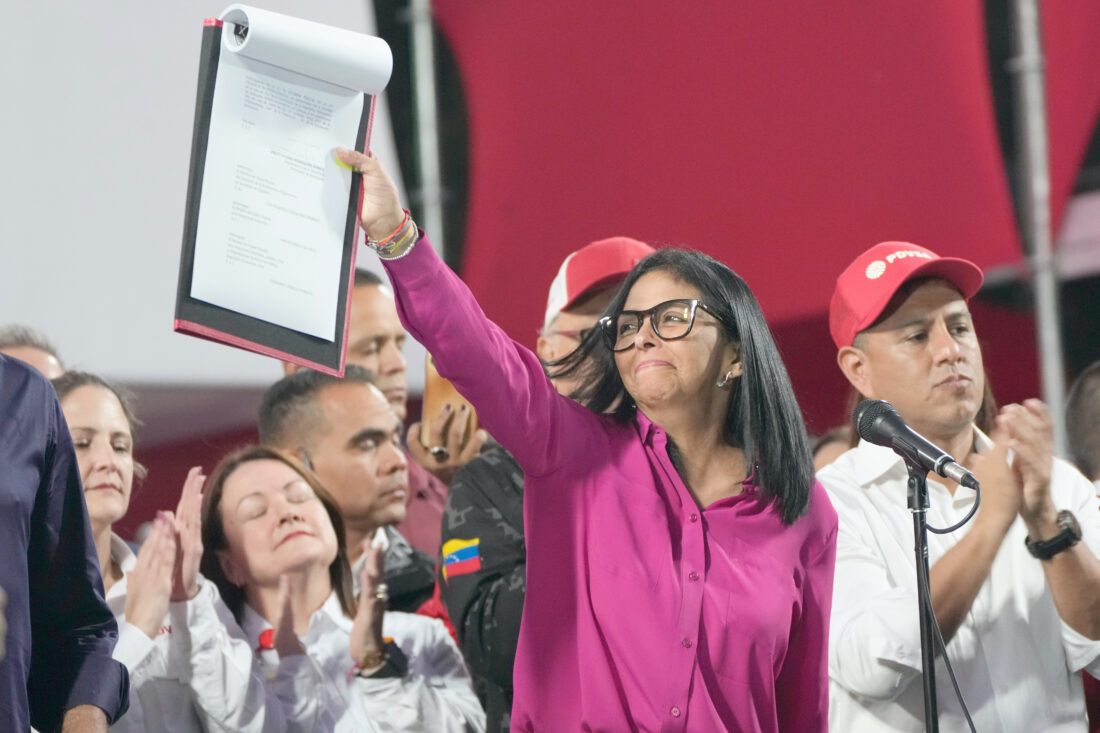
Venezuela’s acting President Delcy Rodriguez takes part in a rally on Thursday holding up a copy of a new law after lawmakers approved legislation opening the nation’s oil sector to privatization, at the Miraflores Palace in Caracas, Venezuela. The Associated Press
CARACAS, Venezuela — Venezuela’s acting President Delcy Rodriguez on Thursday signed a law that will open the nation’s oil sector to privatization, reversing a tenet of the self-proclaimed socialist movement that has ruled the country for more than two decades.
Lawmakers in the country’s National Assembly approved the overhaul of the energy industry law earlier in the day, less than a month after the brazen seizure of then-President Nicolas Maduro in a U.S. military attack in Venezuela’s capital.
As the bill was being passed, the U.S. Treasury Department officially began to ease sanctions on Venezuelan oil that once crippled the industry, and expanded the ability of U.S. energy companies to operate in the South American nation, the first step in plans outlined by Secretary of State Marco Rubio the day before. The moves by both governments on Thursday are paving the way for yet another radical geopolitical and economic shift in Venezuela.
“We’re talking about the future. We are talking about the country that we are going to give to our children,” Rodriguez said.
The legislation promises to give private companies control over the production and sale of oil and allow for independent arbitration of disputes.
Rodriguez’s government expects the changes to serve as assurances for major U.S. oil companies that have so far hesitated about returning to the volatile country. Some of those companies lost investments when the ruling party enacted the existing law two decades ago to favor Venezuela’s state-run oil company, Petroleos de Venezuela SA, or PDVSA.
The revised law would modify extraction taxes, setting a royalty cap rate of 30% and allowing the executive branch to set percentages for every project based on capital investment needs, competitiveness and other factors. It also removes the mandate for disputes to be settled only in Venezuelan courts, which are controlled by the ruling party.
International News
Venezuela’s acting leader signs oil industry revamp

Stage, screen star Fiennes makes Paris Opera debut
Israel recovers remains of last hostage
JERUSALEM — Israel brought home the remains of the last hostage in Gaza on Monday, closing a painful chapter for ...

US aircraft carrier now in Mideast
Daily briefing
Nation Maine Six dead in plane crash PORTLAND — Six people died when a business jet crashed during takeoff ...