
Trending
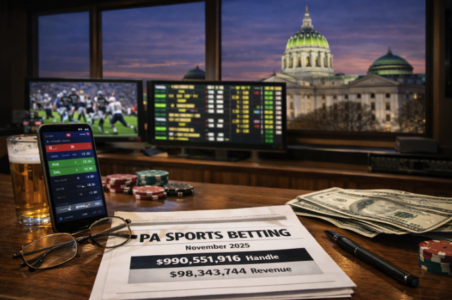
On a crisp autumn morning in Harrisburg, someone somewhere was quietly tallying up nearly a billion dollars. It wasn't receipts from a summer tourist season or an annual tax haul, but the total amount that Pennsylvanians wagered on sports in November 2025, as reported by the Pennsylvania Gaming Control Board. That figure -- $990,551,916 in sports betting handle -- marked a new monthly high for the state and was nearly six percent higher than the same month a year earlier. The taxable revenue from those bets, $98,343,744, was itself a record before accounting for state levies, which added another $35,403,748 to Pennsylvania's coffers. Taken together, the figures marked one of the most significant milestones in Pennsylvania's sports betting history, underscoring just how quickly wagering has moved from novelty to norm.
Taken at face value, these figures might seem abstract: large sums that belong to statisticians. But they tell a story that is both cultural and economic. Gambling here has moved from curiosity to commonplace. What once required a visit to a casino or a discreet phone call can now be accomplished with a few taps on a smartphone, merging seamlessly into the background hum of everyday life. If sports once provided idle conversation over lemonade on a porch, betting now often accompanies that chat, turning idle speculation into a quantified choice.
In this familiar landscape, it is unsurprising that many enthusiasts glance at comparison sites such as Covers.com, where sportsbook incentives – including FanDuel promotions – appear alongside odds and analysis, weighed with the same pragmatic eye once reserved for coupons or daily deals. Betting has become another domestic detail, something to consider and compare rather than recoil from.
Growth Through the Years
Pennsylvania's betting surge did not occur overnight. It has been years in the making, following the state's decision to legalise sports betting in 2018. Since then, the broader gambling market has expanded steadily. In the fiscal year ending June 30, 2025, Pennsylvania's regulated gambling industry generated a record $6.39 billion in total revenue, with sports wagering, casino games and online platforms all contributing to the surge. That revenue produced an astonishing $2.79 billion in tax receipts to support public services ranging from education to infrastructure.
This expansive figure goes well beyond sports betting alone, but it contains within it a clear signal. Betting -- both online and in person -- has become a pillar of the state's entertainment economy. Part of this growth has been fuelled by the rise of online platforms that allow wagering from anywhere in the Commonwealth. In other states and countries, observers have noted similar patterns: convenience and accessibility often translate into increased participation, for better and worse.
Pennsylvania's experience is not unique, but it is among the most pronounced. As one of the largest regulated betting markets in the United States, the Commonwealth often serves as a bellwether for how legalization reshapes consumer behaviour when scale, accessibility and regulation converge.
The Digital Shift and the Rise of Mobile Wagers
One of the most fascinating things about the betting scene in Pennsylvania is its massively dominated online betting market. It has been estimated that no less than 95 percent of wagers placed in the state are done online, with only a handful being done at retail sportsbooks. This trend towards online betting mirrors what is happening in the world as we now conduct banking, shopping, socializing, and even gambling using an item that fits inside the palm of our hand.
The convenience of betting apps -- with live odds, in-play markets and instant settlement -- has reconfigured the relationship between fan and game. Where once a wager might have required a trip to a casino or racetrack, now it can happen in the middle of a barbecue, during a commercial break, or between innings of a baseball game without anyone else in the room ever being the wiser.
This digital evolution has made betting seem less like an adventure and more like another animation on the screen. It sits beside news alerts and weather apps, speaking the same conversational language rather than the coded dialect of old gambling lore.
Culture, Community and Sports Fandom
Pennsylvania's sports culture is distinct and richly textured. Cities like Philadelphia and Pittsburgh strain towards their teams with a devotion that borders on devotion. The Eagles' last triumphant season, the Phillies' autumn aspirations and the Steelers' perennial hopes all create natural opportunities for fans to engage more deeply with the action.
In such a setting, betting can feel like an extension of fandom rather than a separate activity. It provides a way for viewers to invest not just emotionally but interpersonally in the outcomes of games they already care about. In social settings -- bars after work, living rooms during Sunday games -- conversations about plays, strategy and statistics now frequently dovetail into discussions about odds, parlays and potential payouts.
This cultural shift is subtle. It has not required a manifesto or a change in identity; it has crept in alongside the growing presence of betting odds on sports broadcasts, betting analysis in newspapers and, increasingly, in everyday conversation.
Balancing Reward with Responsibility
Of course, there is another side to this story. With increased betting comes increased concern about problem gambling and financial harm. Academic research from institutions that study addiction and behaviour has shown that the availability of legal sports betting correlates in some cases with rising rates of problematic gambling behaviour. This is part of what regulators and advocacy groups have in mind when they build player protections into the market: deposit limits, self-exclusion tools and responsible gaming messaging.
Pennsylvania's regulatory framework, overseen by the Gaming Control Board, reflects this balancing act. The state has attempted to combine economic opportunity with consumer protection, requiring licensed operators to adhere to standards intended to reduce harm. This, in part, helps ensure that betting does not remain a fringe activity but instead operates within a system designed to mitigate its most damaging effects.
Like all regulations, it is a work in progress. The presence of problem gambling services and educational campaigns suggests an awareness that growth carries obligations as well as benefits.
The State as Beneficiary
One of the clearest indicators of how embedded betting now is in Pennsylvania's fiscal fabric is the tax revenue it generates. Millions flow into state and local budgets each month. From supporting infrastructure projects to funding educational initiatives, these funds have become a staple of state planning rather than a one-off novelty.
In November 2025 alone, the tax haul from sports betting surpassed $35 million, a figure that would have seemed astonishing just a decade ago. While some critics might characterise betting taxes as a regressive form of revenue, the practical reality for many policymakers is that this is money that helps balance budgets without raising other levies.
This dual role -- as both entertainment and public financing mechanism -- is a defining feature of the current boom. Betting no longer sits on the cultural margins; it has become part of the economic grammar of the state.
What All of This Means
Will Pennsylvania's betting boom continue its upward trajectory? That remains an open question, influenced by broader economic conditions, regulatory changes and shifts in consumer behaviour. But what seems clear is this: wagering now plays a visible and significant role in the Commonwealth's culture, economy and civic conversation.
Betting has gradually woven into the larger narrative of leisure, technology and community. And for those observers who favour scepticism, it might be worth remembering that every new cultural habit carries with it both promise and caution.