
Sharing space: New discoveries suggest humans lived alongside prehistoric animals for millennia in the Americas
New discoveries suggest humans lived alongside prehistoric animals for millennia in the Americas
Trending
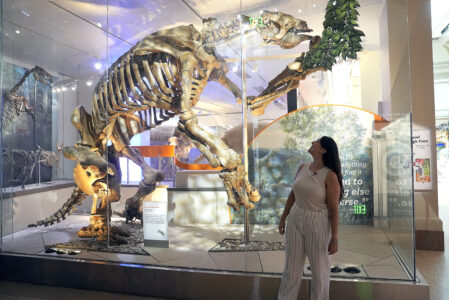
Sloths weren't always slow-moving, furry tree-dwellers. Their prehistoric ancestors were huge -- up to 4 tons -- and when startled, they brandished immense claws.
For a long time, scientists believed the first humans to arrive in the Americas soon killed off these giant ground sloths through hunting, along with many other massive animals like mastodons, saber-toothed cats and dire wolves that once roamed North and South America.
But new research from several sites is starting to suggest that people came to the Americas earlier -- perhaps far earlier -- than once thought. These findings hint at a remarkably different life for these early Americans, one in which they may have spent millennia sharing prehistoric savannas and wetlands with enormous beasts.
"There was this idea that humans arrived and killed everything off very quickly -- what's called 'Pleistocene overkill,'" said Daniel Odess, an archaeologist at White Sands National Park in New Mexico. But new discoveries suggest that "humans were existing alongside these animals for at least 10,000 years, without making them go extinct."
Some of the most tantalizing clues come from an archaeological site in central Brazil, called Santa Elina, where bones of giant ground sloths show signs of being manipulated by humans. Sloths like these once lived from Alaska to Argentina, and some species had bony structures on their backs, called osteoderms -- a bit like the plates of modern armadillos -- that may have been used to make decorations.
In a lab at the University of Sao Paulo, researcher Mirian Pacheco holds in her palm a round, penny-sized sloth fossil. She notes that its surface is surprisingly smooth, the edges appear to have been deliberately polished, and there's a tiny hole near one edge.
"We believe it was intentionally altered and used by ancient people as jewelry or adornment," she said. Three similar "pendant" fossils are visibly different from unworked osteoderms on a table -- those are rough-surfaced and without any holes.
These artifacts from Santa Elina are roughly 27,000 years old -- more than 10,000 years before scientists once thought that humans arrived in the Americas.
Originally researchers wondered if the craftsmen were working on already old fossils. But Pacheco's research strongly suggests that ancient people were carving "fresh bones" shortly after the animals died.
Her findings, together with other recent discoveries, could help rewrite the tale of when humans first arrived in the Americas -- and the effect they had on the environment they found.
"There's still a big debate," Pacheco said.
Scientists know that the first humans emerged in Africa, then moved into Europe and Asia-Pacific, before finally making their way to the last continental frontier, the Americas. But questions remain about the final chapter of the human origins story.
Pacheco was taught in high school the theory that most archaeologists held throughout the 20th century. "What I learned in school was that Clovis was first," she said.
Clovis is a site in New Mexico, where archaeologists in the 1920s and 1930s found distinctive projectile points and other artifacts dated to between 11,000 and 13,000 years ago.
This date happens to coincide with the end of the last Ice Age, a time when an ice-free corridor likely emerged in North America -- giving rise to an idea about how early humans moved into the continent after crossing the Bering land bridge from Asia.
And because the fossil record shows the widespread decline of American megafauna starting around the same time -- with North America losing 70% of its large mammals, and South America losing more than 80% -- many researchers surmised that humans' arrival led to mass extinctions.
"It was a nice story for a while, when all the timing lined up," said paleoanthropologist Briana Pobiner at the Smithsonian Institution's Human Origins Program. "But it doesn't really work so well anymore."
In the past 30 years, new research methods -- including ancient DNA analysis and new laboratory techniques -- coupled with the examination of additional archaeological sites and inclusion of more diverse scholars across the Americas, have upended the old narrative and raised new questions.
"Anything older than about 15,000 years still draws intense scrutiny," said Richard Farina, a paleontologist at the University of the Republic in Montevideo, Uruguay. "But really compelling evidence from more and more older sites keeps coming to light."
In Sao Paulo and at the Federal University of Sao Carlos, Pacheco studies the chemical changes that occur when a bone becomes a fossil. This allows her team to analyze when the sloth osteoderms were likely modified.
"We found that the osteoderms were carved before the fossilization process" in "fresh bones" -- meaning anywhere from a few days to a few years after the sloths died, but not thousands of years later.
Her team also tested and ruled out several natural processes, like erosion and animal gnawing.
The first site widely accepted as older than Clovis was in Monte Verde, Chile.
Buried beneath a peat bog, researchers discovered 14,500-year-old stone tools, pieces of preserved animal hides, and various edible and medicinal plants.
"Monte Verde was a shock. You're here at the end of the world, with all this organic stuff preserved," said Vanderbilt University archaeologist Tom Dillehay, a longtime researcher at Monte Verde.
Other archaeological sites suggest even earlier dates for human presence in the Americas.
Among the oldest sites is Arroyo del Vizcaino in Uruguay, where researchers are studying apparent human-made "cut marks" on animal bones dated to about 30,000 years ago.
While the exact timing of humans' arrival in the Americas remains contested -- and may never be known -- it seems clear that if the first people arrived earlier than once thought, they didn't immediately decimate the giant beasts they encountered.