
Ancient battle site Believed found
Satellite shows researchers the way
Trending
BEIRUT -- Declassified 1970s-era U.S. spy satellite imagery has led a British-Iraqi archeological team to what they believe is the site of a seventh-century battle that became decisive in the spread of Islam throughout the region.
The Battle of al-Qadisiyah was fought in Mesopotamia -- in present-day Iraq -- in the A.D. 630s between Arab Muslims and the army of the Sassanid Persian dynasty during a period of Muslim expansion. The Arab army prevailed and continued on its march into Persia, now Iran.
A joint team of archeologists from the U.K.'s Durham University and the University of Al-Qadisiyah stumbled across the site while undertaking a remote sensing survey to map the Darb Zubaydah, a pilgrimage route from Iraq's Kufa to Mecca in Saudi Arabia built more than 1,000 years ago.
The findings were published Tuesday in the journal Antiquity.
While mapping the route, the team noticed that a site some 20 miles south of Kufa in Iraq's southern Najaf province -- a desert area with scattered plots of agricultural land -- had features that closely matched the description of the al-Qadisiyah battle site described in historic texts.
William Deadman, a specialist in archaeological remote sensing at Durham University, said the Cold War era satellite images are a commonly used tools by archeologists working in the Middle East, because the older images often show features that have been destroyed or altered and would not show up on present-day satellite images.
"The Middle East has developed so much in the last 50 years, both agricultural expansion and urban expansion," he said. Some of the distinguishing features at the al-Qadisiyah site, such as a distinctive trench, were "much more pristine and clear" in the 1970s images, he said.
A survey on the ground confirmed the findings and convinced the team that they had correctly identified the site.
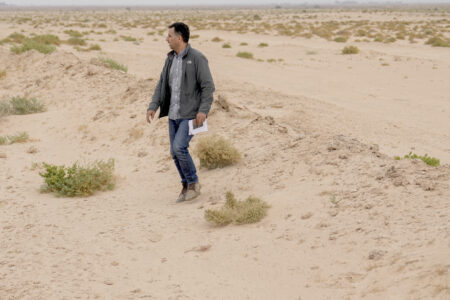
The key features were a deep trench, two fortresses and an ancient river that was reportedly once forded by elephant-mounted Persian troops, said Jaafar Jotheri, a professor of archeology at the University of Al-Qadisiyah who is part of the team that made the discovery. The survey team also found pottery shards consistent with the time period when the battle took place.
Jotheri said that Iraqis of his generation, who grew up under the rule of Saddam Hussein, were all familiar with the battle in minute detail, down to the names of the generals on both sides.
The battle at the time had political connotations -- Iraq was engaged in a devastating war with Iran through much of the 1980s. Saddam pointed to the Battle of Qadisiyah as a harbinger of victory for Iraq.