
Puerto Rico schools clamor for AC
Trending
Public school teacher Angel Muniz grabbed a thermometer and thrust it into the camera as someone recorded him inside his classroom this week.
"It is about 99 degrees," he said in a video posted on social media as seven fans whirred noisily around him.
It wasn't even noon yet, and an advisory that day warned of a heat index of up to 111 degrees Fahrenheit.
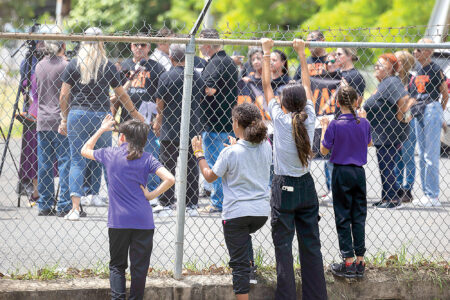
Students and teachers are sweltering in public schools across Puerto Rico that lack air conditioning and are demanding government action as the U.S. Caribbean territory struggles to respond to climate change effects while it bakes under record heat this year.
Last month was the hottest August on the island since record-keeping began. Puerto Rico broke the record of the daily maximum temperature six times and the highest minimum eight times, according to the National Weather Service in San Juan.
It also was the hottest August worldwide, with 2023 the second hottest year on record so far.
Heat advisories for Puerto Rico became the norm this summer, with the island reporting a record 47 nights with temperatures above 80 degrees F.
"Records are being broken almost every day," said Odalys Martinez, National Weather Service forecaster.
Public schools with no air conditioning or whose cooling systems are inoperable due to power outages blamed on a hurricane-battered electric grid are seeking relief, but it's unlikely they'll find it soon.
Last month, Gov. Pedro Pierluisi quietly vetoed a bill that called for air conditioning systems for public schools. The move outraged many, with some calling the situation inhumane as students organized protests.
"It's irresponsible, because this is an emergency. It's a matter of public health," said Yasim Sarkis, a social worker at an elementary school that often lacks electricity and whose son attends a public high school with no air conditioning.
Her school installed air conditioners in April for its 165 students and some 40 employees, but they have yet to be turned on.
"There's not enough current," Sarkis said.
In addition, a power outage last week that has yet to be fixed forced her school to start releasing students at 11:30 a.m. since it has no generator. The electrical problems began after Hurricane Maria pummeled the island in 2017 and razed the power grid that crews only recently started to rebuild.
Pierluisi didn't provide a written explanation of why he vetoed the bill. His spokeswoman, Sheila Anglero, told The Associated Press that any project with a "significant fiscal impact" requires an analysis from the legislature's budget office, a requirement for an island emerging from the biggest U.S. municipal bankruptcy in history.
Air conditioning is considered a necessity by many on this tropical island of 3.2 million people, with government offices, businesses and homes running cooling systems round-the-clock, especially in the summer.
But air conditioning remains rare at public schools, which depend on fans and trade winds that blow through windows with metal shutters.
"Our classrooms have turned into saunas, and the Department of Education has dragged its feet in responding to the situation," said Edwin Morales, vice president of the island's Federation of Teachers.
It's unknown how many public schools lack air conditioning or have air conditioners that don't work because of electrical problems. The island's education department, an oft-criticized bureaucratic behemoth that oversees one of the largest school districts in a U.S. jurisdiction with more than 259,000 students and more than 850 schools, said it's trying to gather that data.
Meanwhile, Puerto Rico's Association of Teachers said that of 2,500 teachers surveyed so far, more than 83% said they don't have air conditioning in their classroom. More than 50% of public schools also have reported a heat-related emergency.
"This is alarming," said Raul Gonzalez, the association's vice president, adding that they've received reports of teachers and students fainting from the heat.