
Elected to serve
‘Peacekeepers’ look for more work and to save the state constable system
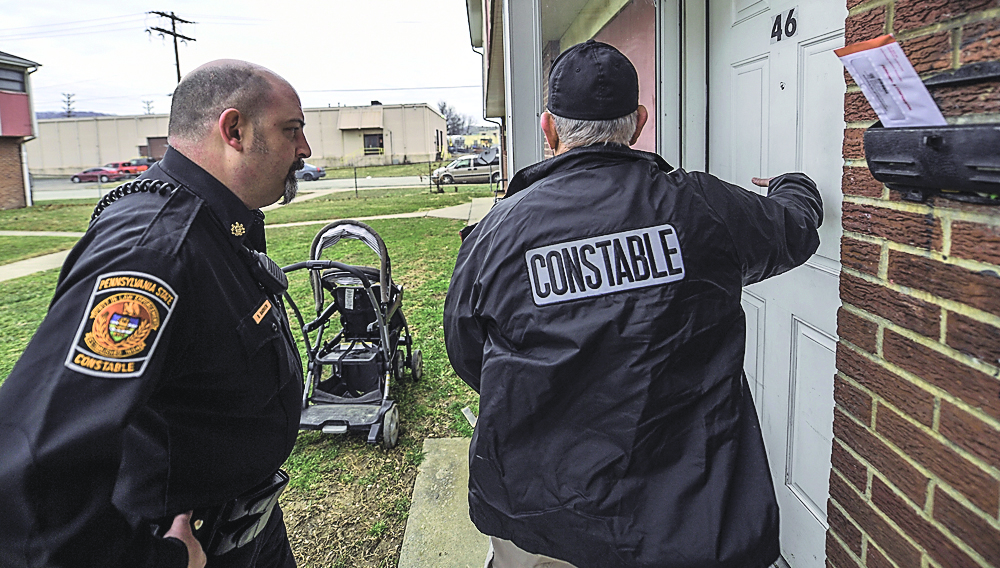
Constables Tom Rushnock and Brian Barbieri serve eviction notices in New Kensington. The Associated Press
There’s never a dull day for Adam Kujawa.
Whether it’s talking to people in Pittsburgh neighborhoods or navigating the back roads of Fayette and Westmoreland counties, the Mount Pleasant constable loves it all.
“It’s basically a day-to-day adventure,” he said.
He dons his vest with an embroidered patch identifying him as a Pennsylvania State Constable and serves paperwork from magistrates in the three counties. He has worked in the elected position since 2011, sometimes in dangerous situations.
“I take a lot of pride in what I do,” he said. “Six days a week, I’m out the door working.”
Constables are getting less training starting this year because of several cost-cutting measures Pennsylvania Commission on Crime and Delinquency officials put into effect to ration a fund that was being depleted.
At the same time, opposing proposed state legislation targeting constables could either create oversight at the county level or eliminate the position altogether.
The role of constable has been fraught with controversy locally in recent years. Westmoreland County officials stripped some duties from them, and Allegheny County officials created a guidebook for how constables should operate.
Some constables expressed frustration that the same level of camaraderie with police and amount of work they experience in other counties doesn’t exist in Westmoreland.
“You have guys that want to do this job, they’re passionate about it, but they’re not able to get the work,” said Kevin O’Donnell, president of the Westmoreland County Constables Association. “The work’s not there in the quantity it should be.”
What they do
Constables are independent contractors who earn money by completing tasks that vary based on the county where they work. Constables are elected for a six-year term where they live, but they can work for district courts anywhere in the state.
They pay for their own uniforms, vehicles, weapons, insurance and other needs.
“The taxpayers don’t have to pay anything to do with me. … I’m self-employed,” said Constable Glenn Wolfgang of Manor. “The criminal has to pay to get arrested or get transported.”
They can serve arrest warrants, handle landlord-tenant complaints and work security for magistrates across the state.
A fee schedule dictates what constables can charge. Examples include $13 to serve someone with a notice and $90 to eject a tenant from a property.
Some fees are paid by the person who filed the court action. In a landlord-tenant complaint, the plaintiff pre-pays the fees and the constable is reimbursed through the district court.
If they’re serving a warrant, the constables’ fees are assessed to the defendants, who then must pay within 15 days. The county can pre-pay constables for that work, and the defendants are expected to reimburse the county.
State law permits constables limited arrest powers and requires that constables keep peace at the polls during elections.
The number of constables in a municipality does not correlate with the amount of residents. For example, Jeannette, New Kensington and Latrobe each have six constables. Hempfield has one, while Rostraver and North Huntingdon each have two. Lower Burrell has four.
In municipalities with ward systems, typically boroughs and cities, one constable is elected in each ward. In places like townships, one or two constables have to visit numerous polling places.
When that happens, a constable can visit multiple places during elections or hire a deputy to help, said Beth Lechman, director of the Westmoreland County Elections Bureau. Some constables can’t fulfill those duties because of full-time jobs or other responsibilities.
“We don’t have one elected for every district,” she said. “They will show up and stay as long as they can.”
If there’s a problem at a precinct that is not staffed by a constable, the judge of elections requests someone from the county or calls police, Lechman said.
Constables get paid $95 for elections no matter how many precincts they visit.
By the numbers
There are about 1,700 constables statewide registered with the state Commission on Crime and Delinquency. About 1,000 of those have completed training through the commission to do court-related work. They have to complete 80 hours of basic training for an initial certification and 40 additional hours to carry a firearm, said Kirsten Kenyon, commission spokeswoman. One basic training class will be offered this year.
To remain certified, constables each year must complete eight hours of continuing education classes and four hours of firearms training, she said. Those amounts all decreased this year. An online platform for continuing education will be in place in 2020.
There are 28 Westmoreland constables registered with the state and 133 in Allegheny County. The majority are certified to carry a firearm while performing their constable duties.
In November, 116 constables were elected in Westmoreland County. About half of them won with write-in votes — some with only a single vote.
Though the Commission on Crime and Delinquency conducts training, the commission does not oversee constables.
Serving a need
A 2011 court order in Westmoreland County ended a practice that permitted constables to serve arrest warrants through district courts. The order required that all criminal, traffic and non-traffic arrest warrants be processed through a central repository — the sheriff’s department.
As a result, Sheriff Jonathan Held said, he instituted a registration process for constables who wanted to serve warrants to prevent them from having hundreds of warrants and wrong arrests. He would issue 10 warrants at a time, mostly for traffic and non-traffic offenses.
One constable is registered but doesn’t do much work, he said.
Constable Brian Barbieri of Lower Burrell works with district courts in northeastern Westmoreland County. Before the court order, he used to be busy.
“We got down to that office at 8 a.m., and we worked all day,” Barbieri said.
Now, it’s hit or miss.
“The courts can’t work without us,” he said. “The sheriff’s (deputies) can’t handle the work. If they eliminate us, it would cost more money.”
The current system is frustrating to District Judge Frank J. Pallone Jr., who has seen the number of warrants skyrocket at his New Kensington office.
Pallone said that as of October 2011, he had 854 outstanding warrants. As of Dec. 31, 2018, he had 2,684 warrants that hadn’t been served.
It’s important to him and District Judge Roger Eckels in Norvelt to oversee constables who work out of their offices and make sure they’re doing the job right.
“There’s just not enough officers up there at the sheriff’s office to do this,” said Eckels, who retired Friday. “I think it’s a flawed system right now. The constables know everybody in their area.”