
Trending
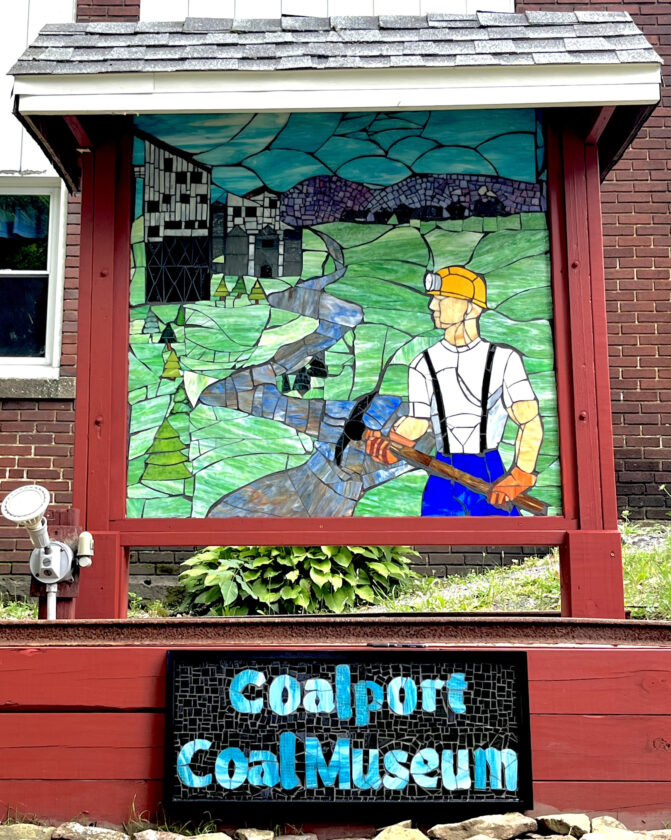
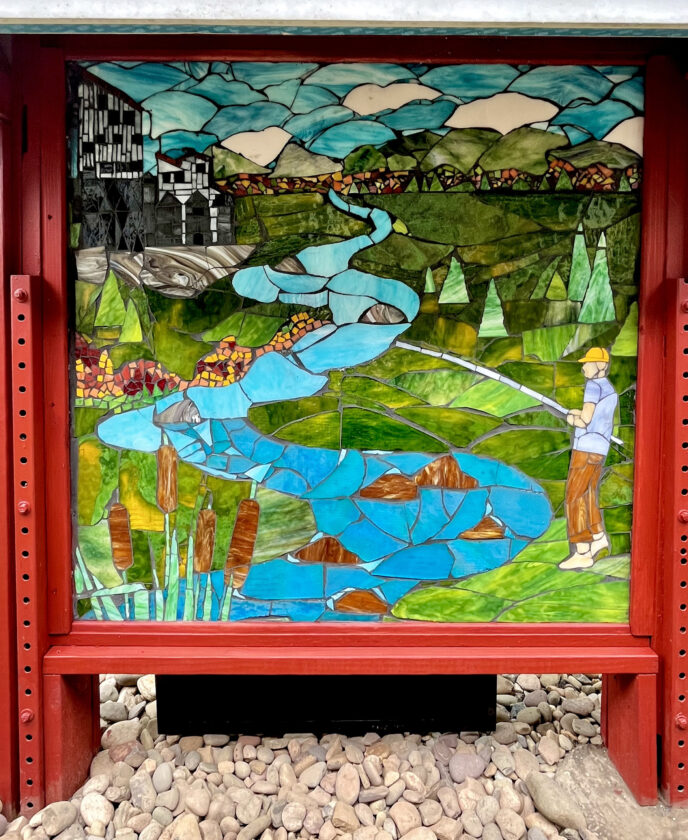
COALPORT -- Students of Glendale High School science teacher Nancy Gobert completed two back-to-back cut glass mosaics on both sides of a wooden sign structure in front of the Coalport Community Building on Forest Street.
Gobert was awarded grant funding for a classroom project illustrating ground water pollution caused by bituminous coal mining -- and using artwork to illustrate and promote public awareness of the pollution, new regulations and cleanup.
This project was made possible through the AIE Partnership of the Pennsylvania Council on the Arts (PCA ) -- a state agency -- and the National Endowment of the Arts (a federal agency).
The PCA Arts in Education Partner in this region is the Galaxy Program of the Central Intermediate Unit #10.
Karen Woods, director of the Galaxy Arts in Education Program, worked with Gobert through a "STEM in PA" grant, and Gobert was also awarded a Glendale Education Foundation "Challenge Grant" for this project.
The students, who incidentally, won the "Governor's STEM in PA" award, wanted to best illustrate this dual legacy of coal mining in west-central Pennsylvania through the use of "cut glass mosaic" media, and Woods suggested muralist Terry Johnson of Port Matilda -- who has worked for more than two decades as a muralist through the PCA with an interest in preserving local history in small towns.
Next up, both Gobert and Woods needed a site to best display this planned artwork with a relationship with coal mining history -- and what better place than the local Coalport Area Coal Museum.
Both ladies were familiar with museum curator, Richard W. Snyder II, who offered the sign structure out in front of the building as the best place on which to attach the murals. However, the signwork needed shored up, which included new 6" X 6" treated lumber ground contact area that were cut to size and more wood placed vertically for the "legs" of the sign post. In addition, new stain was painted on all boards -- and soon an authentic small rail track will be added on top of the front and rear timbers. The coal museum volunteers who did the majority of the hands-on repair, installation and landscaping with rocks of the sign structure included: Bob Jarbeck, John Kucharcik, Bob Counsman, Bill Morrison and Snyder.
The students worked diligently on each of these murals, using attractively-cut glass (generously provided at no cost by Delphi Glass of Lansing, Mich., once they discovered this was a community-oriented project).
Johnston taught them how to initially work with smaller pieces of colored glass -- carefully adding grout while working on a type of thick netting. Once they finished with the small pieces, students progressively worked with larger pieces -- carefully matching up the pieces by shape and color.
Artist Johnson explained the design motif of each of the two separate murals the students worked on -- depicting the dual legacy of coal mining in Pennsylvania. Mural #1 (facing Railroad Street) has a greyish-colored stream meandering running by a replica of the original "Sunshine Mine" tipple in back and a closeup of a miner holding a pick. Mural #2: (on the back/facing the building) portrays the same stream, now rendered in crystal blue and iridescent glass -- portraying a cleaned-up stream, but instead of a miner, it's a man enjoying fishing -- with the tipple still off in the distance (illustrating the bygone era of the bituminous coal mining industry).
The public is invited to view these works of art at the museum on Railroad Street from 1 to 5 p.m. Thursdays or Sundays.