
A rare family of barn owls captivates Manhattanites
Trending
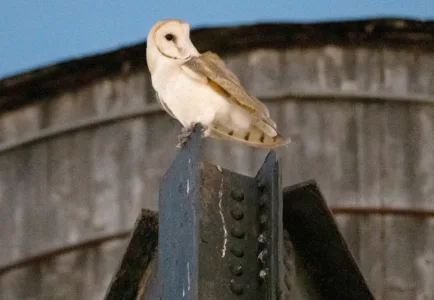
NEW YORK -- Manhattan's Upper West Side has been reveling in the company of its latest celebrities: A family of barn owls nested in a water tower atop a building near Central Park.
This is the first documented instance of barn owls nesting in Manhattan in modern history, according to one expert, and the owls have attracted nightly crowds of people in the street eager to get a glimpse of the elusive birds.
"It was, like, totally shocking," Andrew Farnsworth, a migration ecologist at the Cornell Lab of Ornithology, said of the barn owls. "To the best of our knowledge, like the collective birding knowledge, there hasn't been a nest in, you know, in Manhattan, at least in recorded history."
Word of the barn owl family didn't get around until last week, when Elisabeth Williams, an Upper West Side resident, notified a local news outlet on Oct. 6 that she and her husband saw multiple owls at the water tower atop a building on West 75th Street close to Central Park West.
The couple had previously seen a single owl on an apartment windowsill a few days earlier and were shocked even then, Williams recalled.
"In a place like Manhattan, you normally really have to go out of your way to encounter nature," she said. "And here it was, just sort of right outside our window."
Barn owl sightings are rare in New York City
It's not the first time that birds have captivated New Yorkers. Residents have fallen in love with American woodcocks, who are known to stop in Midtown Manhattan's Bryant Park every year as they migrate north in early spring. And after Flaco the Eurasian eagle-owl died in 2024, dozens of mournful fans gathered to say goodbye to the beloved creature who flew around Manhattan and became a joy to many after someone let him out of his zoo enclosure the previous year.
But barn owl sightings in New York City parks are very rare, according to the New York City Department of Parks & Recreation. New York is at the northern fringe of the barn owl's range and the barn owl population has declined "at an alarming rate" over time, according to the state Department of Environmental Conservation.