
Trending
On a February night in 1964, a veteran TV host and four young musicians from England changed music, broadcasting, popular culture … they changed everything.
The Beatles first appeared on American TV on network news broadcasts. NBC's Huntley-Brinkley Report aired a segment about the Beatles and Beatlemania in England on Nov. 18, 1963. Edwin Newman was the correspondent, and he and his colleagues were rather dismissive of the group, their music and their young fans. At CBS, Walter Cronkite's take was more generous. Their reporter in London, Alexander Kendrick, was pretty condescending as well, but Cronkite liked the segment when he saw it on the CBS Morning News on Nov. 22 and planned to run it on his evening newscast. The assassination of President John F. Kennedy on Nov. 22 in Dallas brought the country to a virtual standstill for four days, and the emotional and psychological hangover lingered for weeks.
It wasn't until Dec. 10 that Cronkite thought his viewers could use a lift from the gloom that had descended upon the country, and he thought that segment would be a nice diversion. That story really got the nation's attention. Young America was soon clamoring for everything Beatles. Radio stations dug up the records that hadn't been successful earlier and played them constantly. Beatles paraphernalia was heavily marketed and sold well. Capitol Records released "I Want to Hold Your Hand" in the United States on Dec. 26 -- they finally had a deal with a major record company in the U.S. -- and by New Year's Eve, it was already a hit. It was the first of six Beatles' songs that reached No. 1 on the Billboard "Hot 100" chart in 1964.
Meanwhile, Ed Sullivan, host/master of ceremonies of a long-running CBS variety show that dominated the Sunday night ratings, arranged a deal with Brian Epstein, the Beatles' long-time manager. Sullivan would bring them to the United States for three consecutive Sunday night shows. The Feb. 16 performance would be broadcast live from the Deauville Hotel in Miami Beach, the third appearance on Feb. 23 would be taped in advance. But the first of the three, a live performance on the Ed Sullivan Show Feb. 9, was the one most anticipated. The two New York shows would be presented at the studio venue now known as the "Ed Sullivan Theater." Epstein also managed to squeeze two extra concert appearances into their tight schedule.
The demand for tickets was insane. CBS received more than 50,000 ticket requests (the tickets were free) for a studio theater that held 728. Getting one of the tickets was largely a matter of luck.
Numerous notables and VIP's called upon favors owed and contacts at CBS to get tickets for their daughters or granddaughters. Only a few succeeded.
When the Beatles arrived in New York, they were greeted by a near-hysterical crowd of teenage girls. They needed a police escort to get into Manhattan, and they needed a phalanx of New York cops to get them around town. All of this was breathlessly reported in the news media.
The Beatles' first weekend in America -- particularly that first appearance on the Ed Sullivan Show -- is widely regarded as a sort of cultural watershed that ignited Beatlemania here and opened America to other performers of the "British Invasion" era -- artists like the Rolling Stones, the Dave Clark Five, Dusty Springfield, and many others. Many sociologists and cultural historians have opined that the Beatles coming to the United States was (at least in a pop culture sense) the beginning of the era that we now commonly view as "The Sixties." Indeed, a veteran television host and four young musicians from the U.K. changed everything that night.
If their first Ed Sullivan Show performance was the "penthouse suite" of their first visit to America, the foundations of that structure were the countless radio stations around the United States that highlighted the band and played their music incessantly. There are endless stories about the big AM Top 40 stations of that era, their star disc jockeys, and their various encounters with the Beatles, both on and off the air.
One of those people was radio entrepreneur Kerby Confer, who has owned stations in Altoona over the years (and whose family, through his daughter's company, still owns a group of stations in town). He was a disc jockey at Baltimore's WCAO then, using the name "Kerby Scott" on the air.
When the Beatles took the train from New York to one of their additional concerts in Washington, one of Confer's colleagues, veteran WCAO newsman Frank Luber, managed to board the train when it stopped in Baltimore and recorded an interview with the Beatles; the tape was brought back to the station and played on the air. If WCAO wasn't already immersed in Beatlemania, that episode had the station and its staff absolutely swimming in it.
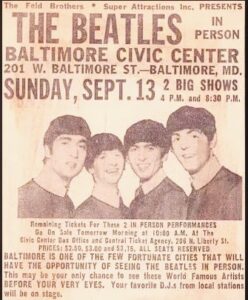
Confer has said that moment influenced his life and his career in ways he didn't fully appreciate at the time. He said he was just another guy doing pretty well on the air in Baltimore, but that moment somehow led to him becoming Baltimore's "Fifth Beatle" and opened other doors for him. He was an obvious choice to emcee one of the Beatles' shows when they performed at the Baltimore Civic Center in September 1964.
He later hosted The Kerby Scott Show -- a local teen dance party program -- on WBAL-TV and it was eventually syndicated elsewhere. Confer soon moved over to the business side of radio in management and ownership. He was very successful in that endeavor, and still owns and operates many radio stations today.
So, Kerby Scott Confer was another young man whose life and career was influenced by that first Beatles weekend in the United States. It's true: for many Americans, a veteran television host and four young musicians from England changed everything on the night of Feb. 9, 1964.
(Mark Wainwright is a longtime radio personality, talk show host, and voiceover performer who has worked on the air at numerous respected radio stations around the United States. He was most recently the morning host at WSYR in Syracuse, New York. A Baltimore native, Mark currently resides in Saratoga County, New York. He can be reached at: markwainwright@earthlink.net)