
Dog tags returned to veteran’s family
Trending
When Bishop Guilfoyle alumna Julia Cacciotti traveled to Vietnam with a group of fellow University of Notre Dame students, she had no way of knowing that they would help bring a piece of a veteran's legacy home to his family.
Cacciotti, who is double majoring in psychology and political science with a minor in cyber security, heard about the one-credit course, Webb's War, being offered through Notre Dame's International Security Center. An NDISC undergraduate fellow with a keen interest in national security and international relations, she decided it would be a good idea to sign up.
Webb's War was taught by Notre Dame professor Michael Desch and James Webb, who has served as a U.S. senator from Virginia, secretary of the Navy and as a Marine in the Vietnam War.
The class took place in October, over the university's fall break, so the students didn't miss any other classes.
"We would read excerpts from one of (Webb's) books and then discuss them in class and then he would talk about the area and give us background about Vietnam itself," Cacciotti said. "Webb has experience and was just sort of preparing us and laying the groundwork for things."
Once in Vietnam, Webb began the trip by taking the students to "touristy, experiential" places first, Cacciotti said. One of the most impactful things the group did was go to different battlefields with Webb.
"Do you know how you can go down to Gettysburg and tour those battlefields, but the tour guide is someone who learned about it, not somebody who was there?" Cacciotti said rhetorically. "So that was really special to have Webb as our tour guide. I thought it put things into a different perspective."
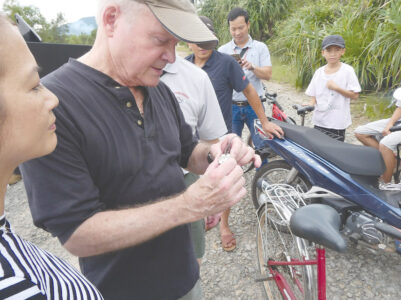
It was on one of those outings that the group was walking through what was a U.S. military airstrip during the war. A Vietnamese rice farmer rode past on a bike, his small son in tow, and stopped to approach them because, as Americans, they "stood out like a sore thumb," Cacciotti said.
The farmer said, "Hello" to Desch and Webb and, discovering Webb was fluent in Vietnamese, mentioned that he had found dog tags while working in the rice fields. Cacciotti said the farmer had one of the dog tags on a keychain and Webb told him he'd be "very interested to see it."
"He had some other ones, I guess, back at his house," Cacciotti said. "And he showed them the dog tag, and right away, they were like, 'What's your price? We're gonna buy it. We need to locate this family.'"
It turned out that the dog tag belonged to USMC Cpl. Larry Hughes, who had lost it while serving near the Da Nang Province in Vietnam in 1966. Hughes survived the war but has since died.
His son, Carl, said that Hughes never mentioned losing the tags.
"His son was very taken aback, very honored to have received those dog tags," Cacciotti said.
"I know (his family) was very grateful to have that dog tag back in their possession, to (have) a little piece of their dad."
Cacciotti described going to Vietnam and coming back with the dog tag as "sort of a full circle trip."
"We went there, we went through museums, we learned about damage, but then to find the dog tag, to reunite that family -- it was a full-circle type of thing," she said.
A spring break mission trip
Traveling to Vietnam wasn't Cacciotti's first experience abroad. After graduating from Bishop Guilfoyle in 2020, she said she had the opportunity to travel to France through Saint Francis University. Then, over Notre Dame University's spring break in March, Cacciotti went on a mission trip to a Catholic orphanage in Honduras.
"That was another eye-opener," Cacciotti said.
Cacciotti said that when the university traveled to Honduras, the State Department informed them that it was a level three advisory.
According to the U.S. Department of State, as of March 1, Honduras is under a Level 3: Reconsider Travel advisory due to crime and kidnapping.
Cacciotti said that the area the orphanage was in and where she would be traveling to with fellow students was in a rural, remote village along the Pacific coast. Since they weren't close to any major cities, she said they weren't at a high risk for any crime and all felt very safe while in the country.
"Getting to learn and experience different parts of the world -- it's important to me, to see how other people live," Cacciotti said. "And I know one thing especially from both trips: it's just very humbling."
The youngest at the orphanage while she was there was 18 months, with the oldest being between 16 and 17 years old, Cacciotti said.
The children would go to church every morning at 5:45, and the missionaries would teach them a ministry lesson, with Cacciotti describing them as "little warriors." She said they would also often play soccer.
After attending Mass at 5:45 a.m. and teaching the children, Cacciotti said she and the other volunteers would eat breakfast before wandering around until lunch. Then, they would have more religion lessons with the children.
Cacciotti said where they were staying there was no cellphone service or running water and that if they wanted to get into contact with family, they had to go to one small building in the village for an internet connection.
Cacciotti said these experiences have been "very humbling" and that they have given her the chance to see what other people have gone through, firsthand -- experiences she plans to utilize in her future career.
"It makes you more aware and understanding that you're able to prevent future war and future conflict with other countries and the need to strengthen our relations with other state actors," Cacciotti said.
Mirror Staff Writer Rachel Foor is at 814-946-7458.