
Providing jobs
Debate rages over sheltered workshop versus competitive employment
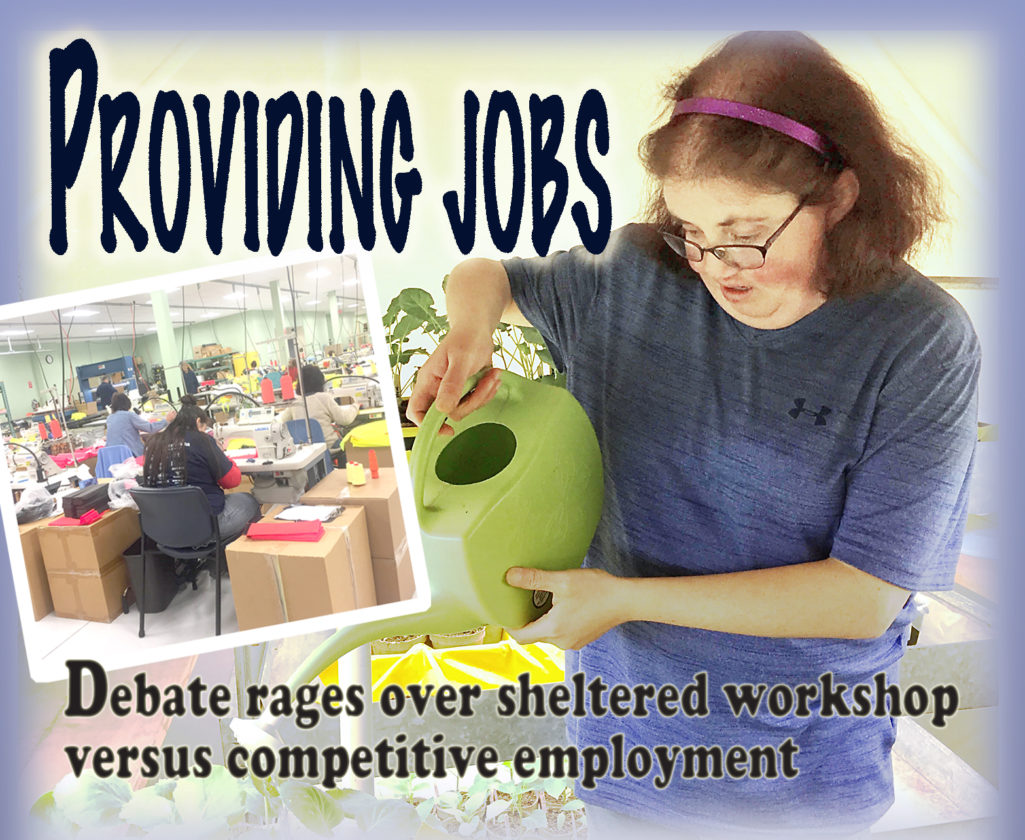
Colleen Wiese, an Altoona resident, waters plants for Skills of Central PA, where she works weekly at the agency’s sheltered workshop. Inset: The Cambria County Association for the Blind & Handicapped Johnstown sheltered workshop sewing department workers make vests for PennDOT employees. Mirror photos by Shen Wu Tan
JOHNSTOWN — Sounds of metal clanking filled a fluorescent-lit sheltered workshop room as employees worked in an assembly-line fashion, manufacturing hangers for electrical and communication lines for underground mines.
The Cambria County Association for the Blind & Handicapped has more than 250 people with disabilities employed at its sheltered facilities. Its Johnstown facility offers different piece-rate jobs including metal bending.
Depending on the rate of production, employees can make less, equal to or more than minimum wage. For assembling rope hangers, the association pays 12 cents a piece or $9.60 for every 80 pieces.
The sheltered workshop opened in 1943 with just a few people who were visually impaired. The association, along with the workshop, expanded in 1968 to include people with other disabilities.
Colleen Wiese, a 41-year-old Altoona resident, works 16 hours each week at a Skills of Central PA sheltered workshop, packing pink sugar packs. She also cleans the Southern Alleghenies Service Management Group office in Lakemont once a week.
Her father, Michael, said she can make anywhere from $7 to $40 biweekly completing piece work for 32 hours at the workshop.
Over the years, Colleen has had a variety of work experiences both in a sheltered facility and in the community, including washing dishes at Pizza Hut and bagging T-shirts for New Pig.
Bill increases job opportunities
Gov. Tom Wolf signed the Employment First Act, which aims to increase competitive employment opportunities for people with disabilities, into law June 19.
The act says in part: “It is the purpose of this act to ensure that individuals with a disability be given the opportunity to achieve economic independence through jobs that pay competitive wages in community integrated settings.”
House Bill 1641, sponsored by Rep. Bryan Cutler, R-Quarryville, requires agencies receiving public funding to first consider competitive integrated employment for people with disabilities eligible to work under state law and to offer resources to support them in their employment.
“This is a win-win for Pennsylvania. Our employers need smart and skilled workers and increasing employment opportunities ensures people with disabilities can achieve greater independence and inclusion in our communities,” Wolf said in a press statement.
The act calls for state agencies to employ individuals with disabilities at a minimum of 7 percent of the overall state workforce but does not require them to give preference in hiring these individuals. It strives to create opportunities for “economic independence” while discouraging work in sheltered facilities.
“It is time for Pennsylvania to more fully live up to the promises of deinstitutionalization and home and community-based living where people with disabilities have the opportunity to work at competitive wages in a wide range of jobs in the private and public sectors,” reads the bill’s memo submitted by Cutler and Rep. Dan Miller, D-Mount Lebanon.
The bill also establishes an oversight commission to set and monitor goals to guide agencies and to report yearly progress.
It precedes a mandate issued by the Pennsylvania Department of Human Services Office of Developmental Programs that requires people with disabilities to spend at least 25 percent of their time in the community. A maximum of 75 percent could be spent in a facility such as a day program or vocational facility.
Facilities would need to be in compliance with the mandate starting July 1, 2019. Agencies are still negotiating this percentage threshold with DHS.
Debate over mandate
The DHS Community Participation Support mandate stirs mixed feelings among those impacted by it.
Some applaud the mandate’s intentions of increasing time in the community and decreasing time in sheltered facilities or workshops, criticizing the setup of these facilities.
John Seely, Empowering Lives co-founder, said sheltered workshops that hire people with disabilities don’t provide transition to integrative competitive employment or give them fair pay, describing the work as “slave labor.”
He added that workshops started out as job training programs but have evolved into “profit centers” that might help people but do not empower them. He said there are rarely plans to transition people out into the community from workshops.
Seely said he thinks sheltered workshops should be phased out, commenting on how Vermont and Massachusetts eliminated these facilities.
“If you want to keep a workshop, then pay minimum wage,” Seely said. “I’m not 100 percent sure that’s the answer, but I think that’s better. At least we are compensating people and not exploiting them.”
One of the goals of his organization is to help people with disabilities find customized employment in the community. He said the CPS mandate is a good starting point for integration and fostering an inclusive, diverse community.
“I think it’s completely reasonable and people can be successful being in our community, honestly, 100 percent of the time,” Seely said.
Others disagreed with Seely, voicing concerns about meeting CPS requirements and saying it should be up to the people to decide how much time they want to spend in the community. Some argue sheltered workshops are safe spaces that offer modified steps, teach job readiness and provide opportunities to socialize.
Richard Bosserman, CCABH president, described the association as a place of “a thousand chances” that gives people with disabilities dignity.
John Stahl, CCABH director of rehabilitation, said some individuals with “severe” disabilities are unable to work in the community. “We’re dealing with individuals and working with them to the best of their abilities. This is where they should be and want to be.”
“We continue to demonstrate that based on their productivity, their intellectual functioning, their social functioning that this is the best place for them,” he said of the CCABH sheltered workshop. “To the individual that would say we are warehousing people, that is absolutely false. The people choose to be here that want to be here.”
Bosserman said if the association got rid of its workshops that pay piece rate, then it couldn’t afford to employ people with disabilities.
Cathy McFee, Skills regional vice president, shared a middle-of-the-road opinion and said it is important to offer a wide variety of choice for families and their “life trajectories,” whether it’s a sheltered workshop or community work.
“I think it’s best as of right now to offer as many choices for people as possible and let them decide. Let them decide and that we as a company be willing to change as needs change,” McFee said. “Having more choices, it’s always a good thing. We want to help support that. We want to support people to make those choices that are best for them.”
She said the transition to more community time is a positive move.
There are 99 people working at the Skills sheltered workshop on Cortland Avenue.
Both Skills and the Cambria County Association for the Blind & Handicapped have started the transition phase to meet the CPS requirements. Skills is increasing staff and vehicles, McFee said.
Although CPS sets a percent for community time, McFee pointed out there is a “variance” process for those who do not want to comply with the mandate.
Working boosts
self-esteem
Colleen Wiese, who has been with Skills for more than a decade, said she is fine with decreasing time in a sheltered facility and increasing work in the community. What matters to her is that she continues to work, no matter in what capacity.
“Colleen loves working here and out in the community,”
Her father, Michael, said. “Finding the work in the community will be a huge task. I hope they can find the work for people.”
“I would like the community to see that whenever you give people a chance, they can accomplish a lot more than you might think,” he added.
For Colleen, working is not about making money, but about the independence, work ethic and interaction with people. It is also a boost to her self-esteem, her father said.
“I feel good. I feel safe. I’m happy,” Colleen said of working. “I feel proud of myself.”
“It gives me something to do during the day. It gets me out with my friends,” she added.
With the money she does earn, Colleen said she likes to spend it on shopping, eating out, going to the movies, renting sports video games and taking vacation trips to Virginia to visit her family.
Mirror Staff Writer Shen Wu Tan is at 946-7457.
Local News
Olympic effort: Special Olympians join police officers in leg of Law Enforcement Torch Run through region
Pennsylvania DHS secretary touts preschool staff bonus program
Gable’s building project seeking artists
Pennsylvania DHS secretary touts preschool staff bonus program
Gable’s building project seeking artists